Walk into any chemist shop in Ludhiana, Guwahati or Coimbatore, pick up ten strips at random, and read the back panel closely. On several of them you’ll find two different names: one company that markets the brand, another that actually made it. The second name is the factory. The first name is the business.
That gap is where almost every new pharma company in India begins. Nearly every guide on how to start a pharma company in India walks you through plant layout, clean rooms and validation protocols — useful if you have ₹3 crore sitting idle, useless if you don’t. The route most people actually take is quieter and far cheaper: register a business, get a wholesale drug licence, hire someone else’s approved plant, and sell under your own brand.
This piece covers that route end to end — the three legal models open to a new pharma company in India, the licences you genuinely need, what it costs in the first twelve months, and the liabilities you carry even when you never touch a tablet press.
A quick note before we begin: drug rules, fees and timelines differ from state to state and change often. Treat every figure here as an indication, not a quote. Confirm specifics with your State Drug Control Authority and a company secretary before you commit money.
The Three Legal Ways to Sell Medicine You Didn’t Manufacture
Almost every conversation about starting an asset-light medicine company in India collapses three very different models into one word: “outsourcing.” They are not the same. They differ in who holds the licence, who carries the blame when a batch fails, and who owns the brand five years from now. Pick the wrong one and you will spend two years building equity that belongs to someone else.
Third-Party Manufacturing (Contract Manufacturing)
You hand a manufacturer your formulation, your brand name and your artwork. They produce it under their own manufacturing licence, in their own plant, and ship it to you in your packaging. You pay per batch.
The licence stays with them. The quality liability, in regulatory terms, largely stays with them too. What stays with you is the brand — the name on the carton, the prescriber relationship, the market. This is the lowest-barrier way to run a pharma company in India, and it’s why a marketing-led firm can go from incorporation to first invoice in about four months.
The catch is control. You are one of forty clients on their production calendar. Your batch moves when they say it moves.
Loan Licence
Here you apply for the manufacturing licence yourself and simply borrow the factory. In practice you file Form 24A with the state licensing authority and, if approved, receive a loan licence in Form 25A for general formulations — Form 27A and 28A cover Schedule C and C1 products such as injectables and biologicals.
The plant belongs to someone else. The licence belongs to you. So does the compliance burden: your name appears on the label as the manufacturing licence holder, your records get inspected, and a drug inspector’s questions land on your desk rather than the plant owner’s.
Founders of a medicine company in India choose this route when they want formulation control and a licence asset in their own name, and when they have the appetite for real paperwork. It is slower and costlier to set up than third-party manufacturing, and not every plant will host a loan licensee.
PCD / Franchise Marketing
The third model reverses the direction entirely. Instead of building a brand, you distribute someone else’s. An established pharma company in India appoints you as its propaganda-cum-distribution partner for a district or a state, gives you monopoly rights in that territory, supplies stock at a fixed rate, and hands over promotional material.
You can start in six to eight weeks with a couple of lakh rupees. The margins are thinner, the brand equity accrues to the parent company, and if they terminate the arrangement, your territory disappears with it. Plenty of people use PCD as a paid apprenticeship — learn the market, build stockist relationships, then launch their own medicine company in India two years later. That’s a sensible sequence.
A Side-by-Side Comparison
| Third-Party Manufacturing | Loan Licence | PCD / Franchise | |
|---|---|---|---|
| Realistic starting capital | ₹5–12 lakh | ₹10–25 lakh | ₹1.5–4 lakh |
| Who holds the manufacturing licence | The plant | You | The parent brand |
| Control over formulation | Moderate | High | None |
| Primary recall liability | Mostly the manufacturer, shared in practice | You | The parent brand |
| Who owns the brand | You | You | Them |
| Time to first sale | 3–5 months | 6–10 months | 6–8 weeks |
| Resale value later | Real | Real | Almost none |
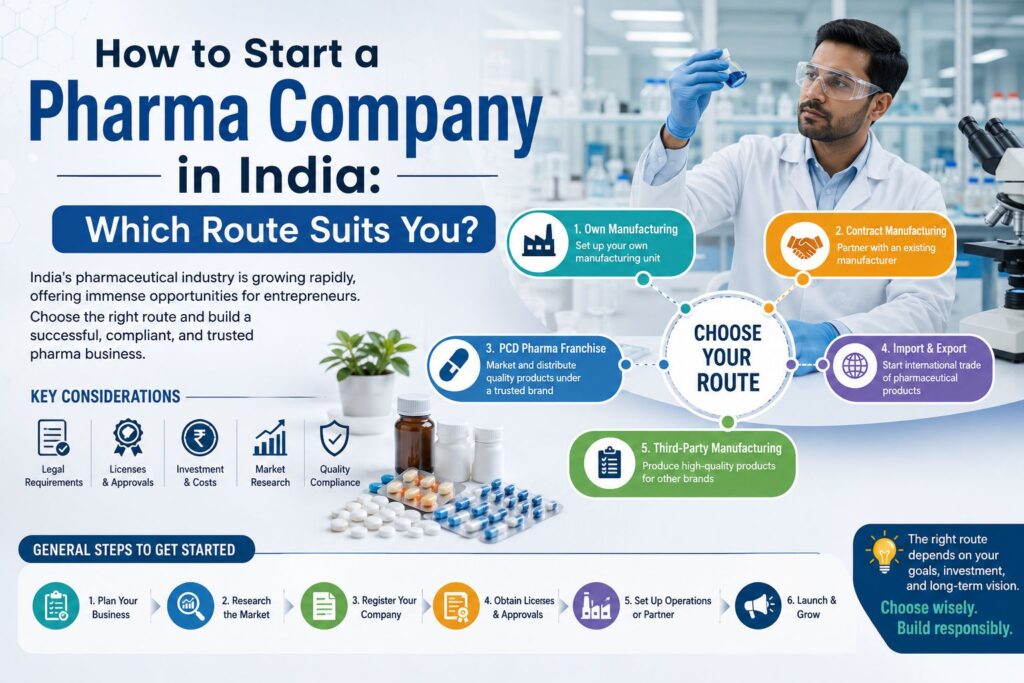
How to Start a Pharma Company in India: Which Route Suits You?
Skip the pros-and-cons lists and answer these five questions honestly. They shape a new pharma company in India more than any spreadsheet will. Your answers will point at one column of the table above.
- How much can you lose without changing your life? If the number is under ₹4 lakh, PCD is the sane entry. Third-party manufacturing needs breathing room for stock that sits unsold for a quarter.
- Do doctors already take your calls? An ex-medical representative with 120 warm prescribers can launch a brand and see movement in month two. Someone starting cold cannot, and should either franchise or budget for a field force.
- How much geography can you physically service? One person covers roughly two districts properly. Three states on paper is three states unserviced.
- Do you want something you can sell in ten years? If yes, you need a brand and a licence in your own name. Franchise revenue is income, not an asset.
- What happens when a form comes back with objections? Some people find licensing paperwork mildly annoying. Others lose three months to it. Know which one you are before you choose the loan-licence route.
Registering the Business and Naming It
Before any drug licence, every pharma company in India needs a legal entity and a name that survives two separate approval processes — one at the Ministry of Corporate Affairs, one at the Trade Marks Registry. Most delays at this stage are self-inflicted.
Choosing a Structure — Proprietorship, LLP, or Private Limited
A proprietorship is fastest and cheapest, and it genuinely suffices if you’re running a single-district franchise with no partners and no plan to raise money. You get a GST number, a current account, a drug licence in your own name, and you’re trading.
A private limited company costs more to set up and maintain — annual filings, audit, a compliance calendar — but it’s what most people choose when they intend to add a partner, take on investors, or eventually sell. It also separates your personal assets from the business, which matters in a product category where a defective batch can trigger claims. If you’re serious about building a medicine company in India that outlives you, incorporate properly at the start rather than converting later.
An LLP sits between the two, and suits a medicine company in India started by two working partners. Two or more partners, limited liability, lighter compliance than a company, but harder to bring outside equity into.
Name Approval Rules Nobody Warns You About
MCA name reservation happens through SPICe+ Part A. Rejections cluster around a few causes:
- The name is too close to an existing company name, including phonetic near-misses.
- It matches a registered trademark held by someone else — a very common reason a promising name for a pharma company in India dies at the first hurdle.
- It uses words suggesting government patronage or regulatory endorsement.
- It’s purely descriptive, offering nothing distinctive.
The suffix you choose also signals something. “Pharmaceuticals” reads like a manufacturer. “Healthcare” and “Life Sciences” read broader and give you room to add devices, supplements or diagnostics later without the name fighting you. “Remedies,” “Formulations” and “Biotech” all carry their own expectations.
Do the trademark search before the MCA search, not after. A name cleared by MCA but blocked at Class 5 is worse than useless — you’ll have letterheads, a bank account and a drug licence in a name you can’t legally defend on a carton.
PAN, TAN, GST and Current Account
Sequence saves rework:
- Incorporation certificate, PAN and TAN (issued together with SPICe+).
- Current account in the entity’s name, at a branch that understands drug-trade documentation.
- GST registration, using the incorporation documents and premises proof.
- Drug licence application — most states want the GST certificate and the rent agreement in the entity’s name, so this comes last.
Applying for the drug licence before GST is the single most common backtrack. Every subsequent document has to match the entity name and address exactly, so fix the address early and don’t plan to move for at least two years.
The Drug Licence You Need (and the One You Don’t)
Here’s the correction that saves people the most money: you do not need a manufacturing licence to own and sell a pharmaceutical brand. A manufacturing licence covers the act of making drugs. If a licensed plant is making them for you, what you need is authorisation to stock and sell — a wholesale drug licence.
This distinction is the whole basis of the asset-light model, and it is where searches for how to start a pharma company in India most often go off the rails, because the results describe a factory the reader was never going to build.
Wholesale Drug Licence — Forms 20B and 21B
Under the Drugs and Cosmetics Act, 1940 and its Rules, a wholesale licence is issued in two parts by the State Drug Control Authority: Form 20B for general allopathic drugs, and Form 21B for drugs falling under Schedule C and C1 — injectables, vaccines, biologicals and similar. Most applicants setting up a pharma company in India take both, because a product list rarely stays confined to plain tablets.
The application (Form 19) goes through the state’s online portal in most states, followed by a physical inspection. The inspector is checking that the premises exist, that they’re fit for storing medicine, that your records are in order, and that a qualified person is genuinely present.
Premises and Storage Conditions
The rules prescribe a minimum area for wholesale premises — commonly 10 square metres, with a larger requirement if you’re combining wholesale and retail at one address. Beyond floor area, inspectors look for:
- A refrigerator with a working thermometer and a temperature log, if you’ll stock cold-chain items
- Adequate racking, with stock off the floor
- Air conditioning or demonstrable temperature control where the product list demands it
- A clearly separated area for expired and returned goods
- A commercial address — a residential flat or a spare bedroom usually fails, and a registered office at your accountant’s address will not pass inspection
Take photographs of the premises with the racking and refrigerator installed before you file. It shortens the inspection conversation considerably.
The Competent Person Requirement
Every wholesale licence needs a qualified person overseeing the sale of drugs. Broadly, that means a registered pharmacist, or a graduate with a stated period of experience in dealing in drugs, or someone with lower academic qualifications and several years of documented experience. States apply this differently, so confirm your candidate’s eligibility with the local drug control office before signing anything.
You’ll need their registration certificate, qualification proof, an appointment letter, and a signed declaration. Two warnings worth taking seriously:
- The paper pharmacist problem. Borrowing a registered pharmacist’s certificate for a fee, with no intention of them ever visiting the premises, is common and is a serious risk. If an inspector arrives and the competent person cannot be produced, the licence is exposed.
- Exclusivity. A pharmacist cannot lend their registration to multiple firms simultaneously. Check that yours isn’t already attached elsewhere.
Timelines, Fees, and What Delays Approvals
Statutory fees are modest — a few thousand rupees per licence category. Consultants charge considerably more, and in most states they’re worth it for the first application from a new medicine company in India.
Realistic timeline from filing to licence in hand is 30 to 75 days, though it stretches badly in states with inspection backlogs. Delays almost always come from the same handful of causes: a rent agreement that doesn’t match the entity name, missing pharmacist documents, a premises photograph that doesn’t show the required storage, or an objection letter that sat unanswered in an email inbox for three weeks. Check the portal weekly. Objection replies filed within days keep your file moving.
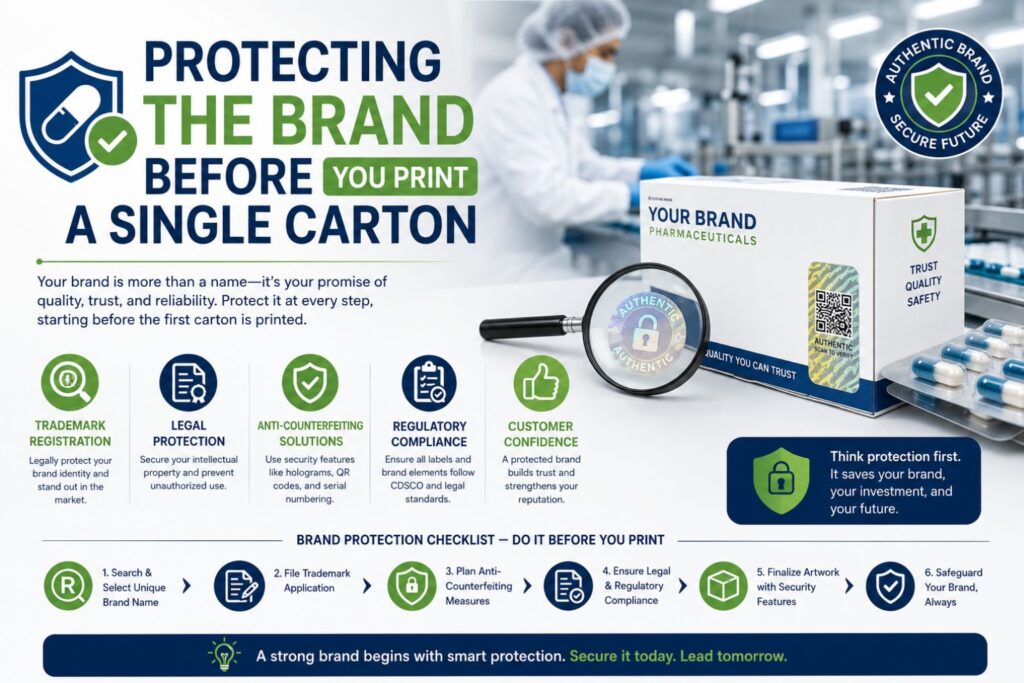
Protecting the Brand Before You Print a Single Carton
The brand is the only real asset an asset-light pharma company in India builds. Prescribers remember brand names, not manufacturers. Protect it before it appears in public, not after a competitor notices it working.
Trademark Search and Class 5 Filing
Pharmaceutical preparations sit in Class 5 of the trademark classification. Government filing fees are currently ₹4,500 per class for individuals, startups and MSMEs filing online, and ₹9,000 for other applicants — small money against the cost of rebranding a product that’s already in the market.
Search the register properly before filing, and search phonetically rather than by spelling. The registry and the courts both look at how a name sounds when a chemist hears it across a counter, not how it’s typed. Names that differ by a single letter or that share a dominant syllable are routinely refused.
Why Brand Names Get Objected in Pharma Specifically
Pharma trademarks face stricter scrutiny than, say, a clothing label, and for a defensible reason: confusion between two similar names can put the wrong molecule into a patient. Courts have repeatedly held that the ordinary standard of “likelihood of confusion” is applied more strictly to medicines, and that a lower degree of similarity can be enough to refuse a mark.
Practical consequences for anyone naming products at a new medicine company in India:
- Avoid names built directly on the molecule (dozens already exist, and they’re weak marks besides)
- Avoid two-syllable names ending in the same sound as a market leader in the same therapy area
- Check the pronunciation in more than one Indian language before you commit
- File in your company’s name, not your personal name, unless you have a reason
Artwork, Barcoding and Mandatory Label Declarations
Your manufacturer will usually supply an artwork template, but the responsibility for what’s printed is shared, and errors get caught at inspection. A compliant carton carries the generic name displayed at least as prominently as the brand name, the composition, the manufacturing licence number and manufacturer’s address, batch number, manufacturing and expiry dates, storage conditions, MRP inclusive of all taxes, and the required warning statements — the Rx symbol and red line for prescription drugs, and the specific schedule warnings where they apply.
Separately, the top-selling brands notified by the government must carry a QR code or barcode enabling authentication and traceability. Even if your products fall outside that list, building barcoding in from the first batch makes life easier later.
Selecting a Manufacturing Partner Without Getting Burned
This is the decision that determines whether your pharma company in India survives its second year. People choose on rate per strip. They should choose on whether the plant will still be compliant, solvent and answering the phone eighteen months from now.
Certifications That Actually Matter
Ask for documents, not claims. This is the point where the best pharma company in India to partner with separates itself from the one quoting the lowest rate:
- A valid manufacturing licence covering your specific dosage form. A plant licensed for tablets cannot legally make your ointment. Check the licence, and check the schedule of products attached to it.
- Revised Schedule M compliance. The updated good manufacturing practice requirements raised the bar significantly on documentation, quality systems, premises and equipment, with staggered timelines for smaller units. Ask where they stand and what evidence they can show.
- WHO-GMP certification and a COPP if exports are anywhere on your roadmap. Retrofitting an export-grade partner later means requalifying your entire product list.
- A current, unexpired FSSAI licence if you plan nutraceuticals alongside drugs.
Verification matters. Certificates get photoshopped. Cross-check the licence number with the state drug control database where one is published.
Auditing a Plant in One Visit
Go in person. Take a chemist friend if you aren’t one. Spend three hours and look at:
- Batch manufacturing records — pick a random batch from six months ago and see how fast they produce the file. If it takes forty minutes, records are being written after the fact.
- The water system — purified water generation, storage loop, and its test records. Water quality quietly determines product quality.
- Quarantine and rejected-material areas — physically separate, clearly labelled, actually used.
- The QC lab — in-house testing with functioning instruments, or everything sent to a third-party lab? Both are legal; the second adds days to every batch.
- Stability data on formulations similar to yours.
- Housekeeping in areas they didn’t prepare for you — the corridor, the store, the change room. Prepared areas tell you nothing.
A plant that resists an audit is telling you something. Walk.
What to Put in the Agreement
Even the best pharma company in India to work with will run on a handshake if you let it, and handshakes are the source of most disputes in this trade. Get a written agreement covering:
- Minimum order quantity per SKU and per batch
- Rate per unit, validity of that rate, and how raw-material price movements are handled
- Batch coding conventions and who assigns them
- Who pays for testing, and which tests are mandatory before dispatch
- Ownership of artwork, dies and packaging material you’ve funded
- Exclusivity — will they supply the same formulation to a competitor in your territory?
- Payment terms and what happens to your stock if you’re late
- Recall liability, spelled out: who bears the cost, who informs the authority, who collects stock from the market
- Notice period for termination and what happens to work-in-progress
Lessons from How the Best Pharma Companies in India Started
It’s worth knowing that the asset-light route isn’t a lesser version of the real thing. Several of the firms now cited as the best pharma company in India in market-share tables began without plants of their own.
Their publicly reported histories follow a similar arc: start by distributing or marketing formulations made elsewhere, build brand recognition and a field force in specific therapy areas, then acquire or construct manufacturing once volumes justified the capital. Mankind Pharma, founded in the mid-1990s, and Alkem Laboratories, which began in the 1970s on the distribution side, are both frequently described this way. Torrent’s early years followed a marketing-first pattern too.
The lesson isn’t that you’ll grow into the best pharma company in India. It’s that the sequence — market first, manufacture later — is a proven path in this industry rather than a shortcut, and the question of which is the best pharma company in India today has a lot to do with brand-building decisions those founders made long before they owned a factory.
Building the First Product List
New founders overreach here more than anywhere else, and it is the fastest way to stall a young pharma company in India. Twenty-four SKUs on the first order sounds like a serious business. It’s actually ₹8 lakh of capital converted into slow-moving inventory with a two-year expiry clock running.
Start with six to ten products. Add only what sells.
Picking Therapeutic Segments You Can Actually Sell
Match the segment to the prescribers you can genuinely reach:
- Anti-infectives and general practice — huge volume, brutal competition, thin differentiation. Works if you have GP relationships and can compete on service.
- Gastro — steady, repeat prescriptions, sensible for a first list.
- Gynaecology — fewer doctors to cover, high-value prescriptions, sticky once you’re in.
- Dermatology — good margins on creams and ointments, and a smaller specialist base to service.
- Nutraceuticals and supplements — easier regulatory path, weaker prescription loyalty, price-sensitive.
- Paediatrics — syrups and drops, high trust barrier, slow to enter and slow to lose.
The right answer is usually the specialty you already worked in. Ex-MRs launching in their own therapy area outperform those chasing a segment because the margins looked better.
Reading Prescription Trends Before Committing to Molecules
Before you finalise molecules, do three cheap things:
- Talk to four stockists. Ask what’s moving, what’s returning unsold, and which new brands entered the last six months.
- Sit in two chemist shops for an hour each. You’ll learn more about substitution behaviour than any report will tell you.
- Check what’s already crowded. If eleven brands of the same combination are being pushed in your district, the twelfth needs a reason to exist beyond your enthusiasm.
Paid prescription-audit data exists and is genuinely useful at scale, but it’s priced for companies several years ahead of you.
Scheduled vs. Non-Scheduled Drugs and DPCO Ceilings
Formulations listed in the National List of Essential Medicines fall under the Drug Prices Control Order, and the NPPA fixes their ceiling prices. You cannot exceed the ceiling, which caps the margin available to fund trade discounts and field promotion.
Non-scheduled formulations are priced freely, subject to the annual increase limit set under the order. This is the main reason a new medicine company in India builds its first list mostly outside scheduled molecules — not to avoid regulation, but because the trade margins in a scheduled product often leave nothing to run a field force with. Keep one or two scheduled products if your prescribers expect them; don’t build the whole list there.
Nutraceuticals and the FSSAI Overlap
The boundary between a supplement and a drug is a regulatory line, not a marketing one. Health supplements and nutraceuticals are governed by FSSAI regulations and need an FSSAI licence, not a drug licence. Make a therapeutic claim on the label and you’ve turned a food product into an unapproved drug.
Many founders run both — an FSSAI licence for the supplement range and a drug licence for the rest. Just keep the claims, the labels and the paperwork strictly separate.
What It Really Costs to Launch
Budgets for how to start a pharma company in India circulate online in two flavours: promotional (₹2 lakh and you’re trading) or discouraging (₹50 lakh minimum). Here is a more honest breakdown for a pharma company in India running the third-party model.
One-Time Setup Costs
| Item | Indicative cost |
|---|---|
| Private limited incorporation, including professional fees | ₹8,000 – ₹20,000 |
| Drug licence statutory fees | ₹3,000 – ₹10,000 |
| Licensing consultant | ₹15,000 – ₹40,000 |
| Trademark filing (per class, MSME) | ₹4,500 + attorney fee |
| Premises deposit and fit-out (racking, fridge, AC) | ₹60,000 – ₹2,00,000 |
| Website, visual aids, initial branding | ₹25,000 – ₹75,000 |
First-Order Costs
Minimum order quantities are the real gatekeeper. Most plants won’t run a batch below roughly 5,000–10,000 units for tablets and capsules, which typically works out to ₹15,000–₹50,000 per SKU depending on composition. Add:
- Packaging material, often ordered in higher quantities than the batch itself
- Third-party testing where you want independent confirmation
- Freight, and the octroi-style local charges some states still apply
- Free samples and physician-sample stock, which cannot be sold
Eight SKUs on a modest first order lands most founders between ₹2.5 lakh and ₹5 lakh.
Working Capital and the Credit Cycle
This is where a promising medicine company in India dies, and it has nothing to do with product quality.
You pay the manufacturer largely upfront — new clients rarely get credit. Your stockist expects 30 to 60 days. Your product then sits in the stockist’s godown until chemists order it, which takes another few weeks. So your money is out for anywhere from 90 to 150 days before it comes back.
Assume you’ll need working capital equal to roughly three months of stock purchases, held separately and never spent on anything else. Founders who skip this end up unable to fund a repeat order precisely when a brand starts moving — the worst possible moment to run dry.
A Sample 12-Month Budget
| Lean | Realistic | Comfortable | |
|---|---|---|---|
| Setup and licensing | ₹1.2 L | ₹2.0 L | ₹3.0 L |
| First stock order | ₹2.0 L | ₹4.0 L | ₹7.0 L |
| Repeat orders (year 1) | ₹2.0 L | ₹5.0 L | ₹10.0 L |
| Field force / travel | ₹1.5 L | ₹4.5 L | ₹9.0 L |
| Promotional inputs | ₹0.5 L | ₹1.5 L | ₹3.0 L |
| Rent, salaries, accounts | ₹1.5 L | ₹3.0 L | ₹6.0 L |
| Total | ₹8.7 L | ₹20.0 L | ₹38.0 L |
The lean column assumes you are the field force. It’s a real scenario and plenty of people have started there — but it caps you at one district for the first year.
Getting Product to the Chemist
A licence and a product list are not a business until stock reaches a shelf. Distribution is where a new pharma company in India converts paperwork into revenue.
Stockist and Distributor Appointment
The standard chain runs manufacturer → C&F agent or super-stockist → stockist → chemist → patient, and trade margins are broadly conventional in the industry — commonly around 10% to the stockist and 20% to the retailer on non-scheduled products, with scheduled products following the margins fixed under the price control order.
For a first-year firm, appointing a C&F agent is usually premature. Supply two or three stockists directly in the districts you can actually service, and expand only when your field activity outruns their coverage. Choose stockists by payment record over size — a large stockist who pays at 90 days is worse for you than a modest one who pays at 30.
Agree the expiry and breakage policy in writing on day one. Unsold stock will come back. Deciding then what happens to it is how relationships end.
Field Force or Franchise — Choosing a Sales Engine
A medical representative in a tier-2 city costs roughly ₹18,000–₹30,000 a month plus travel and incentives — call it ₹4–6 lakh a year fully loaded. That MR needs to generate several times their cost in secondary sales to justify the seat, which usually takes six to nine months.
Franchising sidesteps that. You appoint PCD partners who invest their own effort in their own territory, and you supply them at a fixed rate. Your margin per unit drops sharply, but your fixed cost approaches zero and you can cover eight districts instead of one.
Many founders run a hybrid: own MRs in the home district where the founder has relationships, franchise partners everywhere else. It’s a sensible way to grow a medicine company in India without betting the working capital on salaries.
Promotional Inputs That Comply with UCPMP
The Uniform Code for Pharmaceutical Marketing Practices governs what any pharma company in India can and cannot do with prescribers. In short: information, education and reasonable brand reminders are fine. Gifts, personal favours, travel and hospitality unconnected to a genuine professional purpose are not.
Practically, budget for visual aids, product literature, sample packs, and modest branded reminders. Keep records of what was given, to whom, and why — increasingly expected, and inexpensive to maintain from the start.
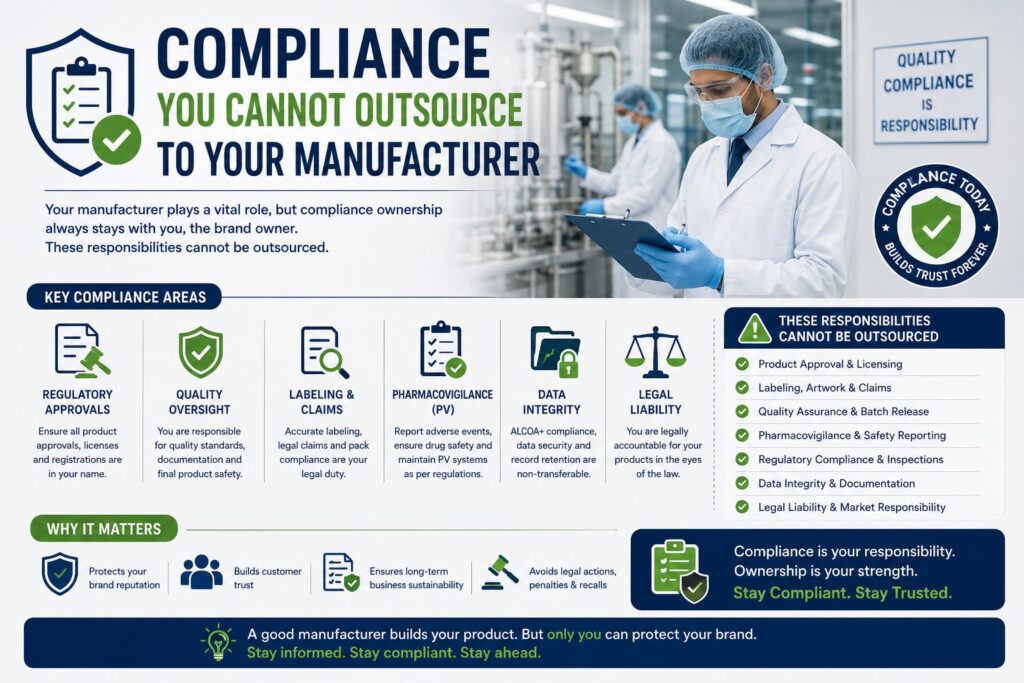
Compliance You Cannot Outsource to Your Manufacturer
The most dangerous assumption in the asset-light model is that compliance sits entirely at the plant. Several obligations attach to whoever holds the wholesale licence — which is you.
Record-Keeping and Batch Traceability
You must be able to answer, quickly, one question: where did batch XYZ go?
That means maintaining purchase invoices, sale bills with batch numbers and expiry dates, a stock register, and credit notes for returns. Keep them for the period your state prescribes — commonly three years, sometimes longer. A simple inventory system that captures batch numbers at both purchase and sale is worth its cost the first time you’re asked.
Recalls and Not-of-Standard-Quality Notices
If a sample drawn from the market fails testing, the drug control authority issues a not-of-standard-quality notice. What follows moves fast: the batch is recalled, stock is traced through the distribution chain, and both the manufacturer and the licence holder answer for it.
Your role is to trace and retrieve stock, notify your stockists in writing, and cooperate with the inspector. This is exactly why the recall clause in your manufacturing agreement matters and why batch-level records aren’t optional. A firm that can produce a full distribution trail in a day is treated very differently from one that cannot.
Annual Renewals, Returns, and Inspections
Every pharma company in India needs a compliance calendar. Keep these on it:
- Drug licence renewal on the prescribed cycle, filed before expiry — late renewal can mean a fresh application
- Monthly and annual GST returns
- Annual ROC filings and audit for companies
- Trademark renewal every ten years
- Immediate intimation to the licensing authority if your premises, competent person, or constitution changes
- Routine inspections, which can happen without notice
None of this is difficult. It’s simply nobody’s job until you make it someone’s job.
When It Makes Sense to Build Your Own Plant
At some point the arithmetic flips, and every growing medicine company in India has to weigh the question properly. Watch for these signals:
- Volume. When you’re ordering the same formulations in large, predictable quantities every month, the per-unit saving from in-house production starts to exceed the cost of servicing plant capital.
- Margin pressure. Contract rates leave 15–25% on the table that a manufacturer keeps. At scale, that’s the difference between a modest business and a substantial one.
- Formulation control. If you want a differentiated combination, a distinctive release profile or a proprietary formulation, hosting it in a third party’s plant becomes uncomfortable.
- Exports. Serious export ambition eventually requires plants you control, with the audits and certifications buyers demand.
- Reliability. When batch delays start costing you prescriptions, you’re paying for a factory whether or not you own one.
Treat this as graduation, not correction. The asset-light years bought you brand equity, market knowledge and cash flow — the three things that make a plant financeable in the first place.
Five Costly Mistakes First-Time Founders Repeat
Launching twenty-two products. A founder in Punjab put ₹9 lakh into a wide first list, sold four SKUs well, and watched the other eighteen expire in a godown. Six products, chosen properly, would have taught him the same lesson for ₹2 lakh.
Skipping the trademark search. Two years of brand-building, a legal notice from a firm with a similar registered mark in Class 5, and a forced rebrand of the one product that was actually working.
Extending credit to win a stockist. A new firm agreed to 90-day terms with a large stockist to get shelf space. The stock moved; the payments didn’t. The firm couldn’t fund a repeat order and lost the momentum it had spent a year building.
Choosing the manufacturer on price alone. Eighty paise cheaper per strip is meaningless when batches run four weeks late during peak season, or when the plant’s compliance status becomes your problem. The best pharma company in India for your product list is rarely the cheapest quote in your inbox.
Leaving the expiry policy undefined. Returns arrive fifteen months in with no agreed formula for who absorbs them. What was a good relationship with a stockist becomes a standoff over ₹40,000 of unsaleable stock.
Questions Founders Ask Before They Commit
Can a non-pharmacist own a pharma company in India? Yes. Ownership carries no pharmacy qualification requirement. What the wholesale drug licence requires is a qualified competent person employed to supervise the sale of drugs — that person must hold the qualifications, not the owner.
How long until the first product is on a shelf? For third-party manufacturing, three to five months is realistic: roughly a month for incorporation and registrations, one to two months for the drug licence, and six to ten weeks for the first batch to be manufactured and delivered. Loan licence routes run longer.
Is a loan licence better than third-party manufacturing? Better for control and for holding a licence in your own name; worse for speed, cost and compliance load. Most first-time founders start with third-party manufacturing and consider a loan licence once they know which products actually sell.
Can this be run from a rented shop-cum-office? Yes, provided the premises meet the minimum area and storage requirements and the rent agreement is in the entity’s name. Purely residential addresses generally fail inspection.
What happens if a batch fails testing after it’s in the market? The authority issues a not-of-standard-quality notice, the batch is recalled, and both manufacturer and licence holder are answerable. You trace and retrieve the stock. Your written agreement should already say who absorbs the cost.
Do I need separate licences to sell in other states? Your wholesale licence permits you to sell from your licensed premises, including consignments to buyers in other states. But if you hold stock at a location in another state, that location needs its own licence. Plan warehousing accordingly.
How do I find the best pharma company in India to manufacture for me? There isn’t one answer — the best pharma company in India for a derma range is not the right partner for injectables. Shortlist by dosage form and licence category first, then compare compliance status, audit findings and delivery record. Rate per unit should be the last filter, not the first.
Can I export without my own factory? Yes. You’ll need an IEC, a manufacturing partner with WHO-GMP and the ability to issue a COPP, and product registration in the destination country. The manufacturer’s certifications carry the export, which is why they’re worth checking on day one.
Where to Start This Week
The honest trade-off is this: going without a factory buys you speed, keeps your downside small, and lets the market — not your capital expenditure — decide which products deserve investment. What it costs a pharma company in India is control over production, a slice of margin, and the ability to promise a delivery date you fully own. For most people asking how to start a pharma company in India, that’s a trade worth making, at least for the first few years.
Two concrete things you can do before next week. First, run a phonetic trademark search in Class 5 for three brand names you like, and an MCA name check for your company name — you’ll know within a day whether your naming plan survives. Second, shortlist four manufacturers who make your dosage form, ask each for their licence copy, product schedule and MOQ, and book a visit to the two who answer properly.
Partner with Us for Third-Party Pharma Manufacturing
Call: 82838 57755
Website: Click Here