Planning to launch your own dermatology medicine brand but don’t have an in-house manufacturing facility? Derma third party manufacturing allows pharmaceutical marketers and brand owners to explore production arrangements with suitable licensed manufacturers.
From antifungal creams and topical gels to medicated ointments, dermatology products involve specific formulation, packaging and quality requirements. Choosing the right manufacturing partner is important for businesses that want to develop a reliable product portfolio.
However, not every manufacturer offers every formulation. Buyers need to confirm the exact product, approved composition, actual manufacturing facility, minimum order quantity (MOQ) and commercial terms before proceeding.
Biomorph Lifesciences Pvt. Ltd., a Chandigarh-based pharmaceutical business, publishes a range of dermatology formulations and information about third-party manufacturing services. Businesses planning a dermatology brand can review these products and enquire about suitable manufacturing arrangements.
This guide explains how derma contract manufacturing works, which products buyers can explore, what affects manufacturing costs and how to prepare a useful quotation request.
Looking to manufacture dermatology products under your own brand?
Send your proposed composition, packaging and expected order quantity to Biomorph Lifesciences for a product-specific discussion.
Request a Derma Manufacturing Quotation | Explore Derma Products
What Is Derma Third Party Manufacturing?
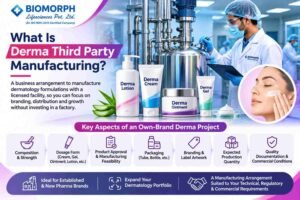
Derma third party manufacturing is a business arrangement in which a pharmaceutical company or brand owner works with an appropriately licensed manufacturing facility to produce dermatology formulations under agreed terms.
Instead of investing in a factory, equipment and production infrastructure, the marketing company can focus on product selection, branding, distribution and commercial development.
The actual manufacturer remains responsible for its manufacturing operations and applicable obligations. The marketing company also has responsibilities under the relevant agreements and laws.
An own-brand project generally involves discussing:
- The required composition and strength
- Cream, gel, ointment, lotion or other dosage form
- Product approval and manufacturing feasibility
- Tube, bottle or other packaging requirements
- Branding and label artwork
- Expected production quantity
- Quality documentation and commercial conditions
Derma third party manufacturing in India can therefore be relevant to established pharmaceutical marketers, new medicine brands and companies expanding into dermatology products.
The goal is not simply to obtain the lowest manufacturing quotation. It is to identify an arrangement suited to the product’s technical, regulatory and commercial requirements.
Dermatology Products for Third-Party Manufacturing Enquiries
Different dermatology products serve different medical needs and may require different production processes.
Businesses searching for a derma products manufacturer in India should prepare a shortlist of exact formulations rather than request a general dermatology price list.
Biomorph Lifesciences publishes several topical formulations in its ointment and topical product catalogue.
1. Antifungal Creams
Antifungal creams are used for certain diagnosed fungal skin infections, depending on the active ingredient and approved product information.
These products can differ in strength, excipients, pack size and labelling.
For example, Biomorph publishes Licobact Luliconazole 1% Cream, listed in a 10 g presentation.
For a manufacturing enquiry, buyers should specify the active ingredient, concentration and required packaging.
A listed branded product is not automatic confirmation that the formulation is available for third-party production under another brand.
2. Acne-Care Gels
Topical gels are used for selected dermatological conditions and can require specific formulation and packaging controls.
Biomorph’s published portfolio includes AcneAll-CN Gel, containing clindamycin phosphate and nicotinamide.
Because clindamycin is an antibiotic, such formulations require responsible prescribing, appropriate approved labelling and suitable product permissions.
Brand owners should confirm the required composition, pack size, regulatory status and manufacturing feasibility.
3. Topical Antibacterial Ointments
Antibacterial ointments are another category within the dermatology pharmaceutical market.
Biomorph lists Bactrocut Mupirocin Ointment USP 2%, published in a 5 g pack.
For bulk or own-brand enquiries, buyers should identify the exact ointment specification and discuss the relevant manufacturing documentation.
Prescription topical antibiotics should not be marketed as general-purpose skincare products.
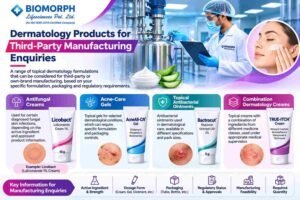
4. Combination Dermatology Creams
Some topical creams contain a combination of ingredients from different medicine classes.
For example, Biomorph publishes TRUE-ITCH Cream, containing neomycin sulphate, beclomethasone dipropionate and clotrimazole.
Such formulations require particular care because their suitability depends on the approved indication and medical supervision.
Brand owners must verify formulation approval, restrictions and applicable labelling before considering marketing or manufacturing arrangements.
Dermatology Product Comparison for Business Buyers
| Published product | Composition | Dosage form | Published pack |
|---|---|---|---|
| Licobact | Luliconazole 1% w/w | Cream | 10 g |
| AcneAll-CN | Clindamycin Phosphate + Nicotinamide | Gel | Confirm current pack |
| Bactrocut | Mupirocin USP 2% | Ointment | 5 g |
| TRUE-ITCH | Neomycin + Beclomethasone + Clotrimazole | Cream | 10 g |
These examples represent products listed in Biomorph’s catalogue. They do not confirm private-label production rights, current stock or a fixed MOQ.
View Biomorph’s Published Topical Products
How Does Third-Party Derma Manufacturing Work?
For a pharmaceutical marketer, understanding the manufacturing process is important before committing to product artwork, packaging materials or inventory.
The following stages describe a typical project.
Step 1: Finalise Your Dermatology Product Requirements
Begin by identifying the exact product you want to market.
Provide the composition, strength, dosage form, target market, packaging and expected order quantity.
For example, an enquiry for a topical antifungal cream should specify the active ingredient and required concentration rather than simply say “fungal cream”.
Clear specifications help manufacturers assess whether the product is suitable for their facilities and permissions.
Step 2: Check Manufacturing Feasibility
The proposed manufacturing source reviews the formulation, available production facilities and applicable regulatory requirements.
Not every facility that produces ointments can manufacture every medicated cream, lotion or gel.
Buyers should request information relevant to the specific product rather than rely on general statements about manufacturing capabilities.
Step 3: Discuss Packaging and Branding
Packaging can affect product handling, labelling, cost and production planning.
Dermatology products may be packed in laminated tubes, suitable containers or other approved configurations.
Brand owners should discuss product naming, artwork, label information and mandatory warnings.
Final artwork must match the applicable approved product details and legal requirements.
Step 4: Request MOQ and Manufacturing Quotation
A detailed quotation should identify the exact formulation and proposed commercial terms.
Discuss batch size, unit pricing, packaging costs, applicable taxes, payment conditions and expected production timelines.
Do not assume that the MOQ for one cream will be the same as the MOQ for another product.
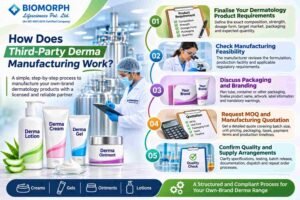
Step 5: Confirm Quality and Supply Arrangements
Before finalising an order, clarify applicable specifications, testing, batch release, documentation and dispatch responsibilities.
Also discuss how artwork changes, quality queries and repeat orders will be managed.
Businesses exploring the wider process can read Biomorph’s third-party pharmaceutical manufacturing services page.
What Should You Check Before Choosing a Derma Third Party Manufacturer?
Choosing a manufacturing partner requires evidence, not just a competitive quotation.
Manufacturing Licences and Product Permissions
Verify the actual facility responsible for producing the proposed formulation.
Confirm that the applicable licences and product permissions cover the relevant dosage form and medicine.
A company’s general pharmaceutical certifications should not be treated as proof that every proposed dermatology product is authorised.
Formulation and Technical Suitability
Creams, gels and ointments can have different formulation requirements.
Manufacturing suitability depends on the ingredients, product specifications, processes and available facilities.
Buyers should confirm that the facility can support the exact approved formulation.
Quality-Control Documentation
Request relevant product specifications and quality documents appropriate to the proposed transaction.
These may include applicable testing arrangements, batch-related records and other documents required under the manufacturing and commercial agreement.
Packaging and Label Compliance
Check tube size, container compatibility, manufacturing details, batch information, expiry particulars and applicable warnings.
Claims made on labels and promotional materials should remain consistent with the product’s approved status.
Commercial Transparency
A manufacturing partner should communicate the relevant MOQ, packaging responsibilities, proposed payment terms and expected order process.
Avoid committing to printed artwork or packaging purchases without confirming feasibility and the parties’ responsibilities.
Derma Medicines and Cosmetic Skincare: Understand the Difference
One important consideration in dermatology manufacturing is the distinction between medicated pharmaceutical formulations and cosmetic skincare products.
Although both may be applied to the skin, their regulatory classifications and permitted claims are not interchangeable.
A prescription antifungal cream, topical antibiotic or corticosteroid preparation is not automatically a cosmetic.
Similarly, a moisturising or cosmetic skincare product cannot simply be promoted as a treatment for a medical condition without meeting the applicable requirements.
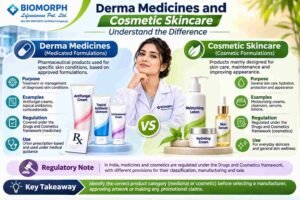
In India, medicines and cosmetics are regulated under the Drugs and Cosmetics framework, with different provisions relevant to their classification, manufacturing and sale.
Brand owners should therefore establish the correct product category before selecting a manufacturer, approving artwork or making promotional claims.
This distinction matters especially when a business wants to expand from pharmaceutical derma products into everyday skincare.
Derma Third Party Manufacturing Cost and MOQ in India
A common question from brand owners is how much it costs to manufacture dermatology products under a proposed brand.
There is no single manufacturing price or minimum order quantity suitable for every dermatology formulation.
Costs may depend on:
- Active ingredients and approved composition
- Formulation complexity
- Product quantity and batch size
- Packaging material and tube size
- Printing and artwork requirements
- Testing and documentation responsibilities
- Applicable taxes and transportation
- Agreed payment and production terms
A proper quotation should be based on a specific proposed product.
Example B2B Request for Quotation
| Enquiry field | Illustrative requirement |
|---|---|
| Buyer type | Pharmaceutical marketing company |
| Product | Topical cream |
| Composition | To be provided by buyer |
| Required strength | As per proposed product specification |
| Pack size | 15 g tube |
| Proposed brand | Buyer-owned brand |
| Approximate quantity | 3,000 tubes |
| Destination | Jaipur, Rajasthan |
| Information required | Feasibility, MOQ, price, documentation and lead time |
The quantity and packaging in this example are illustrative only. They are not a confirmed Biomorph manufacturing MOQ, quotation or available pack configuration.
Providing this information at the start helps make the manufacturing discussion more specific and commercially useful.
Why Consider Biomorph Lifesciences for Derma Manufacturing Enquiries?
Biomorph Lifesciences Pvt. Ltd. is headquartered in Chandigarh and publishes a pharmaceutical product portfolio that includes topical creams, gels and ointments.
For pharmaceutical marketers and brand owners, this offers a starting point for discussing available compositions and suitable manufacturing arrangements.
Published Dermatology Portfolio
Buyers can review existing topical formulations before preparing a shortlist.
The portfolio includes examples across antifungal, acne-related and antibacterial topical medicine categories.
Third-Party Manufacturing Discussions
Businesses planning an own-brand product can provide proposed compositions, dosage forms, packaging and quantities for feasibility review.
Product-Specific Business Enquiries
Rather than requesting an unspecified price list, buyers can identify their required products and ask about the relevant manufacturing and supply arrangements.
Pharmaceutical Portfolio Expansion
Established businesses can also explore complementary pharmaceutical categories through Biomorph’s full product catalogue.
Any proposed manufacturing arrangement is subject to the actual manufacturing source, approvals, product availability and commercial agreement.
Planning Your Own Dermatology Medicine Brand?
Share your proposed composition, tube size, branding requirements and expected quantity with Biomorph Lifesciences.
Discuss Derma Manufacturing Requirements
Derma Third Party Manufacturing vs Derma PCD Franchise
These two business models serve different needs.
| Business model | Suitable buyer | Primary requirement |
|---|---|---|
| Third-party derma manufacturing | Pharmaceutical marketer or brand owner | Medicine production under a proposed brand |
| Derma PCD franchise | Eligible distributor or franchise partner | Distribution or marketing of an existing pharmaceutical portfolio |
Third-party manufacturing involves formulation, production, packaging and the responsibilities agreed with the actual manufacturer.
A franchise arrangement focuses more on product distribution and the commercial rights and obligations of the parties.
For a separate explanation of the distribution model, read Biomorph’s Derma PCD Franchise Guide.
This helps businesses choose the appropriate enquiry route rather than request a franchise when their real requirement is product manufacturing.
How to Enquire About Derma Manufacturing With Biomorph
For a useful manufacturing discussion, prepare the following information:
- Company name and business location
- Proposed dermatology formulation
- Active ingredients and strengths
- Required dosage form and tube or container size
- Expected order quantity
- Proposed branding and artwork requirements
- Target market and delivery destination
- Documents or specifications already available
You can then use the Biomorph contact page to submit your business requirements.
A specific enquiry is more useful than simply requesting the lowest derma manufacturing price.
Frequently Asked Questions: Derma Third Party Manufacturing
1. What is derma third party manufacturing?
Derma third party manufacturing is an arrangement in which a pharmaceutical brand owner works with a suitable licensed manufacturing source to produce dermatology medicines under agreed technical, regulatory and commercial terms.
2. Which dermatology products can be discussed for third-party manufacturing?
Depending on the available facilities and permissions, buyers may enquire about creams, gels, ointments and other topical products. The exact compositions and manufacturing feasibility must be confirmed individually.
3. Can I launch a dermatology cream under my own brand?
An own-brand project may be possible when the formulation, manufacturing permissions, branding arrangements and other requirements are suitable. Availability should not be assumed merely because an existing branded product is listed online.
4. What is the minimum order quantity for derma third party manufacturing?
MOQ depends on the specific product, manufacturing process, packaging and commercial agreement. Ask for a product-specific quotation and batch-size confirmation.
5. What documents are needed for dermatology contract manufacturing?
Requirements depend on the buyer’s business, product classification, manufacturing arrangement and applicable laws. Relevant licences, product specifications, approved labelling and quality documentation should be discussed with the manufacturing partner.
6. What is the difference between third-party manufacturing and a derma PCD franchise?
Third-party manufacturing focuses on producing products under a proposed brand, while a PCD franchise generally involves distributing or marketing an existing range under an agreed commercial arrangement.
7. How can I request a derma manufacturing quotation from Biomorph?
Send the proposed composition, strength, dosage form, packaging, quantity and business location through the Biomorph Lifesciences contact page. The company can review the requirement and discuss applicable next steps.
Conclusion
Choosing a suitable derma third party manufacturing partner requires more than comparing advertised prices. Pharmaceutical brand owners should review formulation suitability, facility permissions, product documentation, packaging, MOQ and commercial responsibilities.
For businesses planning dermatology creams, gels and ointments, Biomorph Lifesciences provides a published topical product portfolio and a route to discuss potential manufacturing requirements.
Start by identifying the exact product you want to market, then request a clear product-specific quotation.
Explore Biomorph’s Dermatology Products | Request a Derma Manufacturing Enquiry
This article is intended for pharmaceutical business information. Product approval, manufacturing capability, licences, packaging, price and commercial availability require individual verification. Medicated dermatology formulations must be marketed and used in accordance with applicable law and approved product information.