Two pharma companies decide to launch the same kind of drug. One spends years building a factory, hiring production staff, and untangling compliance from the ground up, while the other partners with an established manufacturer and has product moving within months. It isn’t much of a race, since the second company gets to patients first almost every time. This isn’t some clever shortcut anymore; it’s simply how the industry operates now, with fresh startups and long-established pharma giants alike asking the same question: is owning a factory still worth it, or does it make more sense to let someone who already does it better handle that job? Here’s what’s really fueling that shift. This growing demand for contract manufacturing pharma is changing how companies plan production and manage expansion. Instead of building every capability internally, pharma businesses can use experienced manufacturing partners to support faster and more flexible growth.
The Quiet Shift Behind Contract Manufacturing Pharma
That’s not something to be suspicious of, it’s just how things get done these days.
Contract manufacturing pharma has settled into the role of quiet workhorse across the industry. Brand-name companies pour their energy into research, marketing, and navigating regulatory approval, while dedicated production facilities handle the physical work of turning formulas into finished medicine.
Why This Shift Matters Right Now
A few things are pushing this trend harder than it’s ever been pushed before. Research budgets keep swelling as drugs get more scientifically complicated to develop. Patents are expiring faster than companies can replace the revenue they generate, which puts pressure on getting new formulations to market quickly.
And even though regulators haven’t loosened their standards, some approval pathways have sped up meaning a slow manufacturing process can no longer be the excuse for missing a launch window.
This is one reason contract manufacturing pharma has become an important option for companies that need to respond quickly to changing market demands.
For many businesses, contract manufacturing pharma provides a practical way to manage these pressures without slowing down product development. It allows companies to access established manufacturing capabilities while keeping their internal teams focused on research and commercial priorities.
From In-House Plants to Outsourced Precision
Go back a few decades and vertical integration was just how pharma operated. Companies built their own plants, staffed their own production lines, and kept the whole operation in-house partly to stay in control, and partly because there weren’t many outside options worth trusting.
Keeping a compliant manufacturing facility running costs a fortune, and most companies would rather not carry that overhead on their books permanently.
That’s where CDMO pharma companies come in; they’ve built their entire business around process development, scaling production, and precision manufacturing, so the pharma brand never has to own a single piece of equipment.
This is one reason contract manufacturing pharma has become attractive to both established companies and newer pharmaceutical businesses. The model offers access to production expertise without requiring every company to invest in a complete manufacturing setup of its own.
What Exactly Is a CDMO in Contract Manufacturing Pharma
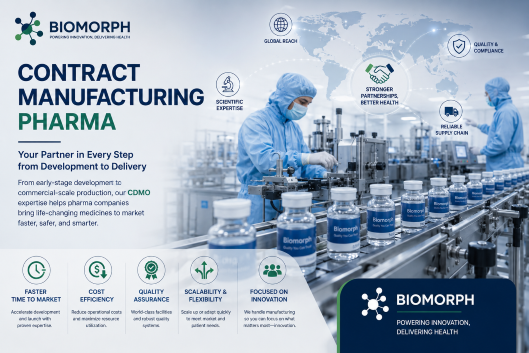
Spend a little time reading about contract manufacturing pharma and one acronym keeps popping up everywhere: CDMO. It’s short for Contract Development and Manufacturing Organization and that “D” right in the middle is doing a lot of heavy lifting compared to a standard CMO.
A plain contract manufacturer takes a formula that’s already locked in and produces it, no questions asked. A CDMO pharma partner shows up much earlier in the process shaping how the formula is built, refining the steps needed to manufacture it, and working out how to take something that worked in a small lab batch and turn it into a process that runs at commercial scale.
Why the “Development” Piece Matters So Much
That early involvement is easy to overlook, but it changes everything. Plenty of drugs look great in a controlled lab environment and then fall apart the moment someone tries to mass-produce them.
CDMO pharma companies exist to catch that gap before it becomes a problem fixing stability issues, tweaking formulations so they can actually be manufactured at volume, and designing processes sturdy enough to survive regulatory inspection.
It’s also why this model fits so naturally with where drug development is headed. Biologics and specialty therapies aren’t anything like the simple tablets pharma used to churn out by the millions.
They demand partners who genuinely understand the underlying science not just people who know how to run a machine.
CDMO vs. Traditional Manufacturing Partner -The Real Difference
- A traditional manufacturer sticks to production, packaging, and standard quality checks, working strictly off a formula that’s handed to them.
- A CDMO stretches across formulation development, analytical testing, regulatory paperwork support, and full production frequently staying involved from early trials all the way through commercial launch.
The Forces Pushing Pharma Companies Toward Outsourcing
No single reason accounts for how fast contract manufacturing pharma has taken off. It’s really several pressures hitting all at once.
Shrinking Margins From Patent Expirations
Patent cliffs sit at the top of that list. The moment a blockbuster loses exclusivity, generics rush in almost immediately, and the margins that used to fund an entire in-house production operation stop making sense.
Companies dealing with that squeeze often realize outsourcing costs far less than keeping half-empty factories running.
The Growing Complexity of Modern Therapies
Then there’s the manufacturing itself, which has gotten a lot harder. Biologics and cell or gene therapies bear almost no resemblance to producing a standard tablet.
They call for cleanroom conditions, cold-chain handling, and specialized equipment that most companies would never be able to justify building for just one or two products.
Regulatory demands pile on even more complexity. Selling a drug across several countries means dealing with a patchwork of compliance rules, inspection standards, and paperwork requirements, the kind of expertise that takes years to build from scratch but already lives inside seasoned CDMO pharma companies.
Small Biotechs and the Manufacturing Problem They Can’t Solve Alone
For early-stage biotech companies, none of this is optional; it’s basic survival. Most have no factory, no production staff, and definitely no time to build either from the ground up.
For these companies, contract manufacturing pharma can turn manufacturing from a major obstacle into a manageable part of the product journey.
There’s an upside buried in that dependency, though. It flattens the playing field. A tiny biotech with genuinely groundbreaking science but zero manufacturing capability can now go head-to-head with much larger competitors, simply by teaming up with the right CDMO.
Inside the Modern Contract Manufacturing Pharma Relationship
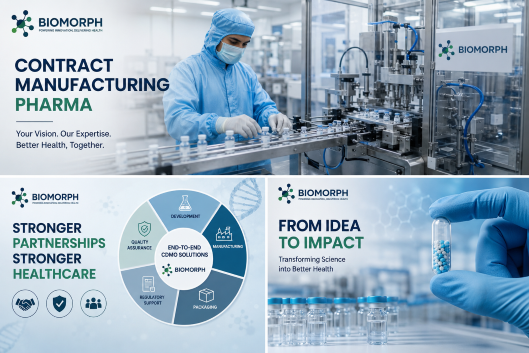
There used to be a time when outsourcing meant placing an order and waiting for a truck to show up. That kind of arms-length arrangement barely exists anymore in contract manufacturing pharma. Companies now treat their manufacturing partners as something closer to an internal team than an outside vendor.
Long-Term Alliances Over One-Off Contracts
You can see this most clearly in how the deals themselves are put together. Rather than negotiating a single order, pharma companies are locking in multi-year agreements.
CDMO pharma partners in some cases putting money directly into expanding production capacity together, or splitting the financial risk of scaling up a therapy that hasn’t proven itself yet.
What Pharma Brands Look for Beyond Price
What companies actually care about when picking a partner has shifted as well. Cost still factors in, sure, but it’s rarely the thing that tips the decision anymore. These days, brands are sizing partners up on:
- Flexibility :will they be able to pivot fast if trial results shift what production actually needs to look like?
- Speed : how quickly can they move from a development-stage process to churning out commercial volumes?
- Technical depth : do they have genuine hands-on experience with complex drug types, or just the standard stuff?
Red Flags Pharma Brands Watch For When Selecting a CDMO
Not every CDMO pharma company is a good match, and companies that have been through this before know exactly what warning signs to look for.
Capacity issues are usually the first thing to check if a partner that’s already running at full tilt won’t have room to grow alongside you later. A shaky quality track record is just as concerning, since even one compliance slip-up at a facility can push back an entire product launch.
Choosing the right partner isn’t just a box to check during due diligence; it can genuinely make or break how smoothly a product actually gets to market.
Where Contract Manufacturing Pharma Growth Is Happening
Growth inside contract manufacturing pharma isn’t happening evenly across the board. A handful of drug types are pulling well ahead of everything else.
The Rise of Complex Modalities
Biologics, antibody-drug conjugates, and cell and gene therapies are leading that charge, mostly because they’re too technically demanding for most companies to handle in-house.
These treatments rely on living cell cultures, tightly controlled environments, and manufacturing steps that look nothing like producing a standard pill which explains why the appetite for skilled CDMO pharma partners keeps growing.
Sterile and Injectable Manufacturing as a Growth Niche
Sterile and injectable production has turned into its own specialty within this broader trend. Vaccines, biologic drugs, and anything administered in a hospital setting all need contamination-free production lines, which are expensive to build.
Even trickier to run without a slip. Instead of taking on that burden themselves, plenty of pharma companies now hand that work to CDMO pharma companies that already run tested, compliant sterile facilities.
The Geographic Shift in Manufacturing Hubs
Where production actually happens is changing too. Asia and portions of Europe are still the dominant manufacturing hubs, but talk of reshoring bringing production closer to home has gained real traction, largely because of what everyone learned when global supply chains cracked under pressure a few years back.
The Risks Nobody Talks About in the Outsourcing Conversation
Outsourcing fixes a lot of headaches, sure, but it creates a fresh set of its own ones that don’t get nearly enough honest attention.
Supply Chain Fragility and Single-Source Dependency
Depending on just one manufacturing site is probably the biggest risk of all. Even a highly capable facility can go down overnight, a natural disaster, a regulatory shutdown, doesn’t matter what triggers it and suddenly an entire product line grinds to a halt.
Quality Control Outside Company Walls
Keeping quality in check gets trickier once production moves outside your own four walls. Oversight now depends on audits, regular reporting, and a fair amount of trust, rather than someone walking the floor every day.
IP protection deserves its own careful look too. Working this closely together means sharing sensitive formulation data early on, so the contract terms around who owns what need to be airtight before any real collaboration begins.
How Companies Are Building Resilience Into Their CDMO Strategy
Once these risks become obvious, the logical move is figuring out how to manage them and plenty of companies have gotten good at it. Building resilience into contract manufacturing pharma doesn’t mean stepping back from outsourcing. It means doing it with more care.
Dual-sourcing has become one of the go-to safeguards. Rather than betting everything on one facility for a critical product, companies now qualify two separate CDMO pharma partners who can both produce the same drug if needed.
What This Means for the Future of Drug Production
Assuming things keep moving the way they’re moving, contract manufacturing pharma is on track to look pretty different in the years ahead and not just in terms of who’s running the machines.
Consolidation Among CDMO Pharma Companies
Consolidation looks like the biggest change coming. Smaller CDMO pharma companies keep getting scooped up by bigger players hoping to widen their service list and reach new regions in one move, rather than building that capacity from the ground up.
For pharma brands, that likely means dealing with fewer partners overall but ones capable of handling everything from early-stage formulation to full global supply under a single roof.
As these trends continue, contract manufacturing pharma is likely to become even more important for companies seeking speed, flexibility, and access to specialized production capabilities.
Automation and Digital Manufacturing on the Rise
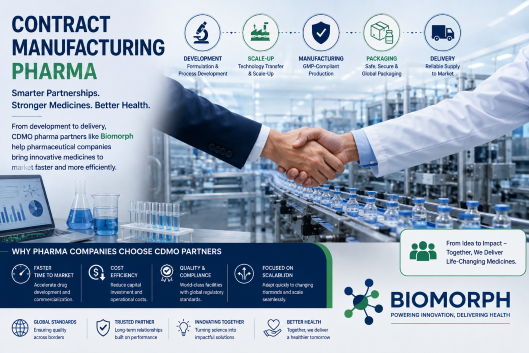
The manufacturing floor itself is changing too. Digital process controls, live monitoring, and AI-driven quality checks are becoming the norm inside contract facilities rather than optional extras.
This isn’t purely about trimming costs, it’s about spotting problems earlier and producing more reliable batches, which matters a great deal when a single mistake can trigger a regulatory red flag.
Redefining What It Means to Be a Pharma Company
Maybe the most interesting change is a bit more abstract. As more physical manufacturing shifts to outside partners, what it even means to “be” a pharma company is quietly being rewritten.
More and more, these companies function like science and strategy shops chasing new compounds, running trials, steering through regulatory approval while depending entirely on CDMO pharma partners to handle the hands-on work of actually making the product.
None of that makes manufacturing any less critical, though. If anything, it raises the pressure on picking the right partner, since the people actually producing the medicine now carry more weight on their shoulders than they ever did before.
Conclusion
The pharma industry isn’t simply handing off production anymore, it’s rethinking what it even means to be a drug maker in the first place. Contract manufacturing pharma has grown from a cost-saving fallback into a core piece of how medicine reaches patients, whether that’s a young biotech leaning on a CDMO just to survive its first clinical trial, or an established giant co-funding new production capacity alongside a partner. The companies treating their CDMO pharma relationships as genuine partnerships, not just outsourced labor, are the ones best set up to move quickly, handle risk intelligently, and keep pace with a pipeline that keeps getting more complicated by the year.
Frequently Asked Questions
Q. What is contract manufacturing pharma?
It refers to a pharmaceutical company handing off drug production to a specialized outside manufacturer, rather than building and operating its own manufacturing facilities.
Q. What’s the difference between a CDMO and a regular contract manufacturer?
A standard contract manufacturer produces a drug based on a formula that’s already been finalized. A CDMO pharma partner steps in much earlier, contributing to formulation development, process design, and scale-up before production even starts.
Q. Why are pharma companies relying more on CDMO pharma companies?
Climbing R&D costs, expiring patents, and increasingly complex biologics and cell therapies have made in-house manufacturing both costly and impractical, pushing more companies toward experienced outsourcing partners.
Q.Is outsourcing manufacturing risky for pharma companies?
It can be, if it isn’t managed properly. Dependency on a single supplier, quality oversight, and protecting IP are all genuine concerns which is exactly why many companies now rely on dual-sourcing and tighter audits to keep those risks in check.
Q.Can small biotech startups use contract manufacturing too?
Definitely many depend on it entirely. Without a factory of their own, startups rely on CDMO pharma partners to move their drugs from lab-scale development all the way through clinical and commercial production.
To Learn More : Click Here