
India doesn’t just make medicine for itself — it stocks pharmacy shelves in more than 200 countries. Somewhere in the world right now, a patient is swallowing a tablet stamped “Made in India” without giving it a second thought. That quiet reach is what makes this sector worth understanding, whether you’re an importer hunting for a reliable supplier, an investor scanning the market, or simply curious about who sits behind those labels. What follows is a plain-spoken look at the biggest names, how they earned their spots, and what you should weigh before signing with any of them.
Why India Sits at the Center of Global Pharma Supply
The nickname isn’t marketing fluff. India supplies close to a fifth of the planet’s generic medicines by volume and roughly 60% of the world’s vaccine demand. Behind that output sits an enormous compliance backbone — the country hosts more USFDA-approved manufacturing plants than any nation outside the United States. High quality at a low price is a hard combination to beat, and it’s exactly why global buyers keep coming back.
What India actually ships — generics, APIs, vaccines, and biosimilars
The export basket is broader than most people assume. Finished formulations and biologicals make up around three-quarters of what leaves the country, but that headline hides a lot of variety: injectables, tablets, syrups, active pharmaceutical ingredients, vaccines, and a fast-growing slice of biosimilars. Some firms ship the raw chemistry that other companies turn into pills. Others handle the whole journey from molecule to blister pack.
Key export destinations, from the US and EU to Africa and Latin America
The United States is the single largest customer, absorbing roughly a third of India’s total pharmaceutical shipments. After that, the map spreads out — the UK, Brazil, France, and South Africa all rank near the top, with Africa, Latin America, and Southeast Asia soaking up affordable generics at scale. In the 2024–25 financial year, total exports crossed the $30 billion mark, growing about 9% year over year. The government is openly chasing a $100 billion target by 2030, and the current pace suggests that isn’t wishful thinking.
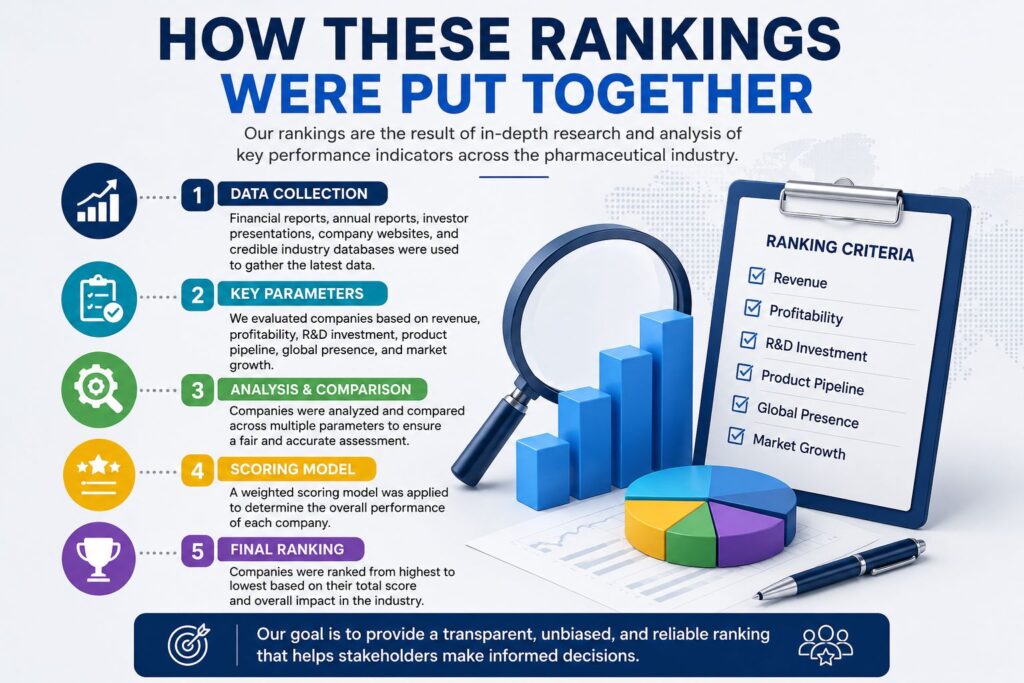
How These Rankings Were Put Together
The metrics that matter — export revenue, market reach, and regulatory approvals
Ranking pharma firms purely by domestic sales would paint a misleading picture, so this list leans on export-relevant signals instead: overseas revenue, the number of countries served, the count of regulatory approvals in strict markets, and the depth of each company’s product catalogue. A firm can be huge at home and still be a modest exporter — and vice versa. Keeping the lens on international performance is what makes the top pharma export companies in India stand apart from simply the largest ones.
Why a “full list” beats a top-five roundup
Most articles stop at five names and call it a day. That’s tidy but incomplete. The top ten exporters alone control more than 60% of India’s pharma export value, and the companies sitting just outside that group are often the ones with the freshest pipelines and the sharpest growth. A fuller view gives buyers real choice and gives readers a truer sense of how deep the bench actually runs.
A quick note on data sources and timeframes
The figures here draw on trade data through the 2024–25 fiscal year and early FY26 updates from India’s export promotion bodies. Rankings shift quarter to quarter as approvals land and shipments clear, so treat this as a well-grounded snapshot rather than a frozen scoreboard. Before committing to any supplier, always pull the most current numbers.
The Full List of Top Pharma Export Companies in India
Here’s the lineup that consistently anchors the roster of top pharma exporters in India, starting with the household names and working outward to the challengers.
Sun Pharmaceutical Industries — scale and specialty reach
Sun sits at the top, and it isn’t especially close. As the world’s fourth-largest specialty generic maker, it moves medicine into more than 100 countries from a network of over 40 manufacturing sites. Its edge isn’t just volume — a growing specialty portfolio in dermatology and ophthalmology lets it earn margins that pure-generic rivals struggle to match.
Dr. Reddy’s Laboratories — generics and API strength
Dr. Reddy’s built its name on complex generics and a serious active-ingredient business. It’s deeply embedded in the US and European markets, and its dual strength — selling both finished drugs and the chemistry behind them — gives it a resilience that single-focus firms lack.
Cipla — respiratory and emerging-market footprint
Cipla is the go-to name for respiratory medicine and has long championed access in lower-income regions. Its inhalers and HIV therapies opened doors across Africa decades ago, and that goodwill still translates into steady demand. Few companies balance commercial reach and public-health credibility quite so smoothly.
Aurobindo Pharma — volume-driven US exports
If Sun wins on specialty value, Aurobindo wins on sheer throughput. A huge share of its revenue rides on US shipments, powered by one of the widest generic product ranges in the country. It’s a workhorse — high volume, tight costs, relentless output.
Lupin — complex generics and inhalation portfolio
Lupin has quietly become a specialist in the hard stuff: complex generics and inhalation products that are genuinely difficult to manufacture and therefore harder for competitors to copy. That technical moat keeps it firmly among the top pharma export companies in India year after year.
Zydus Lifesciences — diversified therapeutic range
Formerly Cadila Healthcare, the Ahmedabad-based Zydus commands a meaningful chunk of the country’s pharma export share. Its catalogue is unusually broad — transdermals, vaccines, biosimilars, APIs, animal health, and standard formulations all under one roof — which cushions it against any single market softening.
Biomorph Lifesciences — A Growing Name in Pharma
Beyond the established pharmaceutical leaders, Biomorph Lifesciences is emerging as a trusted name in the healthcare sector, with a focus on quality-driven pharmaceutical, Ayurvedic, and nutraceutical solutions. The company is expanding its presence through PCD pharma franchise opportunities, pharmaceutical product distribution, and third-party manufacturing solutions, serving business partners across domestic and international markets. With a commitment to quality, customer-focused partnerships, and a growing product portfolio, Biomorph Lifesciences aims to build long-term value in the evolving global pharmaceutical industry.
Torrent, Glenmark, Divi’s, and other heavyweight names
Beyond the front-runners sits a cluster of formidable players. Glenmark leans on research-led dermatology, respiratory, and oncology products across some 80 countries. Divi’s Laboratories is a global powerhouse in APIs and custom synthesis, supplying ingredients to drugmakers worldwide. Torrent brings a strong branded-generics and cardiovascular presence. None of these should be treated as second-tier — they simply specialize.
Mid-tier and fast-rising exporters worth watching
The most interesting movement is often below the giants. Firms like MSN Laboratories punch well above their size in DMF filings, and a wave of nimble contract manufacturers and specialty-focused exporters is climbing fast. For buyers willing to look past the obvious names, this tier can offer sharper pricing and more attentive service.
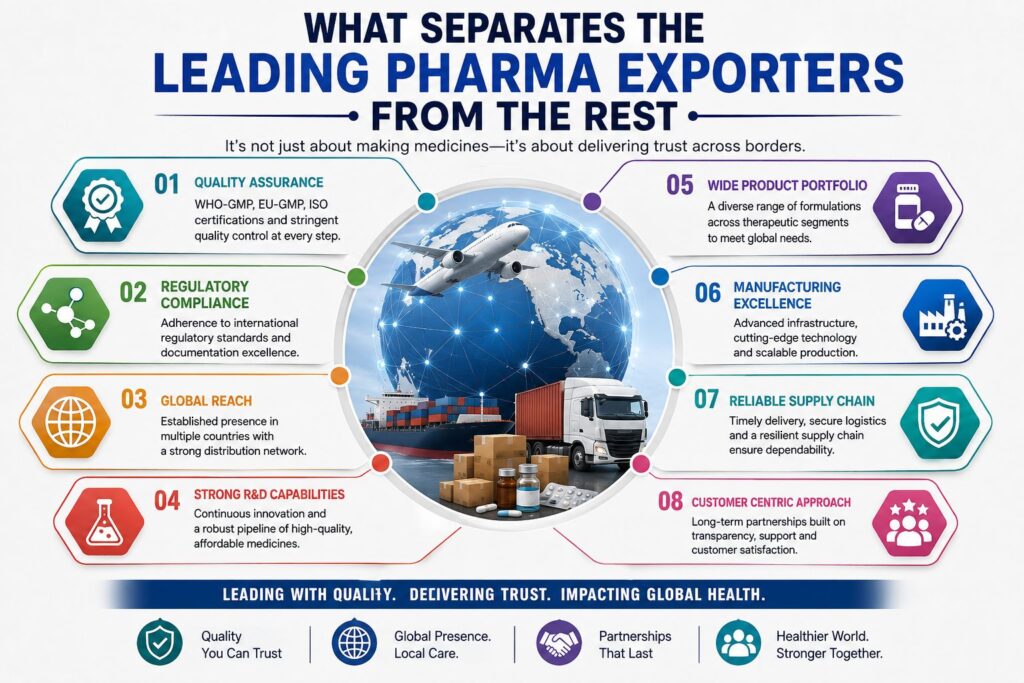
What Separates the Leading Pharma Exporters From the Rest
Regulatory muscle — USFDA, EMA, and WHO-GMP approvals
In this business, paperwork is power. A plant cleared by the USFDA, the European Medicines Agency, or under WHO-GMP standards can sell into markets that pay premium prices. The firms that dominate the list of top pharma exporters in India are, almost without exception, the ones with the cleanest inspection records and the most approvals to their name.
R&D spending and product pipelines
The leaders reinvest heavily — many put 6% to 8% of revenue back into research. That money funds biosimilars, complex generics, and novel delivery systems that keep the pipeline stocked years ahead. A thin pipeline today usually means shrinking exports tomorrow, so this metric quietly separates the durable from the fragile.
Manufacturing capacity and cost advantages
India’s real superpower is producing to Western quality standards at a fraction of Western cost. Scale amplifies that: bigger plants spread fixed costs thinner and absorb bulk orders without breaking a sweat. It’s the core reason global buyers keep the top pharma export companies in India on speed dial.
Product Categories Driving Export Growth
Generic formulations and their global demand
Generics remain the engine room. As healthcare systems everywhere strain under rising costs, affordable copies of off-patent drugs are less a luxury than a necessity — and India is the world’s most dependable supplier. This category alone accounts for the lion’s share of export value.
Active Pharmaceutical Ingredients (APIs) and the China question
Here’s the sector’s open secret: India still leans on China for a large portion of its bulk-drug raw materials. That dependency became painfully visible during pandemic-era supply shocks. In response, policy and industry are pushing hard to build domestic API capacity, and the firms that crack this will hold a serious strategic edge.
Vaccines, biosimilars, and the next growth wave
The future tilts toward higher-value products. Biosimilars — cheaper versions of expensive biologic drugs — represent a massive opportunity, and India’s vaccine capacity is already world-leading. Expect the next decade of growth among top pharma exporters in India to be driven far more by these categories than by ordinary tablets.
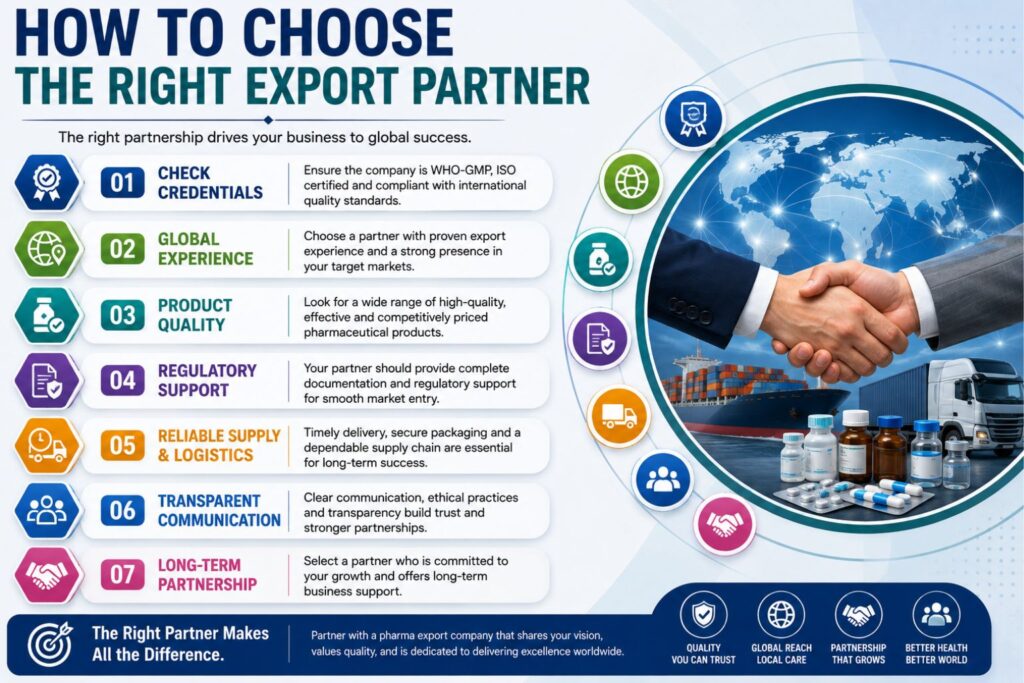
How to Choose the Right Export Partner
Verifying certifications and compliance history
Never take a certificate at face value. Confirm the specific plant supplying your order holds the approvals your market demands, and dig into its inspection history for warning letters or import alerts. A company-wide certification means little if the exact facility making your product has a troubled record.
Matching therapeutic focus to your market
Pick a partner whose strengths line up with what you actually sell. If your market runs on respiratory or oncology products, a generalist won’t serve you as well as a specialist will. The best supplier for a competitor may be entirely wrong for you.
Red flags buyers and importers should never ignore
A few warning signs are worth memorizing:
- Vague or evasive answers about regulatory status and inspection outcomes.
- Prices that sit far below the market — quality corners are usually being cut somewhere.
- No traceable documentation for the batch or the source of ingredients.
- Reluctance to let you audit the facility or provide references.
Any one of these deserves a hard second look before money changes hands.
Headwinds and Opportunities Ahead
Pricing pressure and regulatory scrutiny abroad
Life at the top isn’t frictionless. Generic prices in the US have been under sustained pressure for years, squeezing margins, and foreign regulators have grown stricter about plant inspections. A single adverse finding can freeze a product line and dent a firm’s standing overnight.
Government schemes like PLI shaping the sector
On the supportive side, New Delhi’s Production Linked Incentive scheme is nudging companies to manufacture more raw materials at home and invest in advanced production. Combined with a push toward greener, more digital operations, these policies are gradually reshaping how the industry competes.
Where the top pharma exporters in India are heading next
The trajectory points upward and upmarket. As the sector chases its $100 billion export ambition, the winners will be the firms that move beyond commodity generics into specialty drugs, biosimilars, and complex chemistry. The top pharma exporters in India that adapt fastest to this shift are the ones most likely to still be leading a decade from now.
Quick Answers to Common Questions
Which company is the largest pharma exporter in India?
Sun Pharmaceutical Industries holds the top position by a comfortable margin, ranking as the fourth-largest specialty generic company in the world and supplying medicine to well over 100 countries.
What are India’s biggest pharma export markets?
The United States leads by a wide gap, taking around a third of total shipments. The UK, Brazil, France, and South Africa follow, with broad demand across Africa, Latin America, and Southeast Asia.
How do Indian exporters keep prices competitive?
It comes down to scale, efficient manufacturing, a deep talent pool, and lower operating costs — all delivered while meeting the strict quality standards that Western regulators demand. That blend is why the top pharma export companies in India remain the default choice for affordable, dependable medicine worldwide.