Walk into any pharmacy, gym, or online marketplace, and you meet a wall of tablets, gummies, protein tubs, and immunity shots. Behind every one of those labels sits a business making quiet decisions about what actually goes into the bottle — and those decisions matter, whether you are a shopper trying to spend wisely or a founder hunting for a production partner. This guide cuts past the marketing gloss to examine the nutraceutical companies genuinely earning their reputation, what separates the real leaders from the loud ones, and how to pick a name you can stake your health, or your brand, on.
The Fast Rise of the Nutraceutical Industry
A decade ago, most people bought a multivitamin out of vague habit. Today, they read supplement facts panels the way they read nutrition labels on cereal. That shift in behaviour has turned a once-sleepy corner of health into one of the most dynamic sectors in consumer goods, and it has pushed the best nutraceutical companies from the fringes of retail into the mainstream. Recent industry estimates place the global market well past the half-trillion-dollar mark and climbing at a steady clip year after year.
Where nutraceuticals sit between food and medicine
The word “nutraceutical” is a mash-up of “nutrition” and “pharmaceutical,” and that hybrid identity explains almost everything about the category. These are products derived from food sources — vitamins, minerals, herbal extracts, probiotics, amino acids, plant compounds — that aim to deliver a health benefit beyond basic nourishment, yet stop short of claiming to treat disease the way a licensed drug does.
Picture a spectrum. On one end sits an apple; on the other, a prescription statin. Nutraceuticals live in the wide middle: more targeted than an everyday meal, gentler and more preventive than medication. A turmeric capsule standardised for curcumin, an omega-3 softgel, a magnesium sleep formula — each borrows the credibility of science while staying rooted in nature. That in-between position is exactly why the space is booming, and why so many nutraceutical companies now invest in clinical backing to prove their formulas do what the label suggests.
What’s fuelling the surge in demand for nutraceutical products
Several forces are pushing people toward nutraceutical products at once, and they reinforce each other. Together they explain why demand for nutraceutical products keeps outpacing almost every other category in health and wellness.
- Prevention over cure. After years of rising healthcare costs, consumers would rather support immunity, gut health, and energy today than manage a chronic condition later. Nutraceutical products fit that mindset perfectly.
- Ageing populations. Older adults are the heaviest users of joint, heart, and cognitive formulas, and there are simply more of them every year.
- Fitness and self-optimisation. Protein powders, creatine, electrolytes, and recovery blends have moved from bodybuilding niche to everyday routine.
- Convenience formats. Gummies, effervescent tablets, sachets, and single-shot bottles have made supplements pleasant instead of a chore, widening the audience dramatically.
- Information access. People research ingredients online, compare brands, and hold companies to a higher standard than ever before.
Put together, these trends explain why shelves keep expanding and why new nutraceutical products launch almost weekly.
Why the companies behind the shelf now matter more than ever
Here is the uncomfortable truth: the supplement aisle is only lightly policed compared with prescription medicine. In most markets, a product can reach the shelf without the years of pre-approval a drug requires. That freedom fuels innovation, but it also means the burden of trust shifts onto the manufacturer.
When two bottles claim the same thing, the difference lives in what you cannot see from the front label — the sourcing, the testing, the factory, the honesty of the dosage. That is why the reputation of nutraceutical companies has become the real product. A consumer is not just buying vitamin D; they are buying the assurance that the pill contains the amount stated, free of contaminants, made by people who take the responsibility seriously.
What Sets a Nutraceutical Company Apart as a Leader?
Plenty of brands call themselves the best. Very few can defend the claim when you look closely. The genuine leaders tend to share a handful of unglamorous strengths that rarely make it into their advertising.
Quality standards, certifications, and testing rigour
Certifications are the closest thing this industry has to a shared language of trust. Look for GMP (Good Manufacturing Practice) compliance, WHO-GMP for globally traded goods, ISO quality-management certification, and, depending on the region, third-party seals such as NSF or independent lab verification.
But a logo on a website is only a starting point. Serious nutraceutical companies test raw materials on arrival, test again during production, and test the finished batch before it ships — checking identity, potency, and the absence of heavy metals, microbes, and adulterants. The best treat testing as a cost of doing business, not an optional extra. If a company is vague about how it verifies what goes into its nutraceutical products, that vagueness is your answer.
Research depth and the strength of their product portfolio
A single hero product can build a brand, but it cannot sustain a leader. The companies that stay on top invest in research and development — funding or citing human studies, standardising active ingredients, and refining delivery so the body actually absorbs what it swallows.
A strong portfolio also signals maturity. When a company offers well-formulated options across immunity, digestion, sports nutrition, women’s health, and healthy ageing, it usually means the formulation team is deep, the supply relationships are stable, and the quality systems can scale. Breadth done properly is a sign of competence, not dilution.
Manufacturing capability and supply consistency
Ideas are cheap; making the same excellent product a million times in a row is hard. Leading nutraceutical manufacturing companies own or tightly control their production, run validated processes, and can guarantee that batch 500 performs exactly like batch one.
Supply consistency is the quiet superpower here. A brand that runs out of stock every quarter, or whose potency drifts between orders, will lose customers no matter how clever its marketing is. The companies that endure are the ones that treat reliability as a feature.
Reputation, transparency, and customer trust
Finally, trust is cumulative. It is built through clear labelling, honest claims, responsive customer service, and a willingness to publish what many rivals hide — sourcing details, test results, and the actual dose of the active ingredient rather than a proprietary blend that conceals it. In a category where the consumer cannot inspect the goods themselves, transparency is not a nice-to-have. It is the entire relationship.
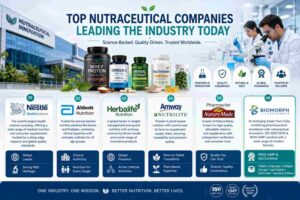
Top Nutraceutical Companies Leading the Industry Today
The list below spans global giants and fast-rising specialists. It is not a strict ranking — a multinational selling wellness drinks and a focused contract manufacturer serve very different needs — but every name here has earned its place through quality, scale, or genuine expertise. Details reflect current, verifiable information at the time of writing.
Nestlé Health Science
The health-focused arm of the world’s largest food company, Nestlé Health Science sits at the very top of the industry by revenue, driven by a portfolio that stretches from medical nutrition to consumer supplement brands. Its scale gives it research muscle few can match, and its acquisitions over recent years have pulled respected vitamin and wellness names under one roof. For consumers, that translates into science-backed nutraceutical products with the reassurance of deep quality infrastructure behind them.
Abbott Nutrition
Best known for names like Ensure and Pedialyte, Abbott Nutrition blends clinical credibility with everyday accessibility. The company’s roots in medical nutrition mean its formulas are frequently developed with hospital and recovery settings in mind, then adapted for the wider public. Standout categories include adult nutritional shakes, paediatric nutrition, and hydration — an area where clinical heritage genuinely shows in the product.
Herbalife Nutrition
A global name in weight management and sports nutrition, Herbalife has built a vast direct-selling network around protein shakes, teas, and targeted supplements. Whatever one thinks of its distribution model, the company operates large-scale manufacturing and a broad catalogue that reaches customers in dozens of countries. Its strength lies in meal-replacement and active-lifestyle nutraceutical products with a loyal, community-driven following.
Amway (Nutrilite)
Through its Nutrilite brand, Amway is one of the oldest and most recognisable players in the space, notable for controlling much of its supply chain — including growing many botanicals on its own certified farms. That seed-to-supplement control is rare and gives the brand a real story around traceability. Its portfolio leans heavily on plant-based multivitamins, phytonutrients, and daily-wellness formulas.
Pharmavite (Nature Made)
Pharmavite, the company behind Nature Made, has spent decades building trust in the mainstream vitamin aisle, particularly in North America. Its reputation rests on consistent quality, verification from independent bodies, and a no-nonsense approach to everyday essentials like vitamin D, fish oil, and multivitamins. For shoppers who want reliable basics without hype, it remains a benchmark among nutraceutical companies.
Biomorph Lifesciences
Among the rising names emerging from India’s fast-growing manufacturing base, Biomorph Lifesciences stands out for pairing pharmaceutical discipline with nutraceutical flexibility. Founded in 2014 and based in Chandigarh, the company is an ISO 9001:2015 and WHO-GMP certified manufacturer with a genuinely broad range — tablets, capsules, softgels, syrups, injectables, protein powders, and modern formats like gummies and sachets.
What makes Biomorph particularly relevant to entrepreneurs is its end-to-end model. Alongside its own products, it offers third-party, PCD, and private-label nutraceutical manufacturing, handling everything from formulation to compliant packaging with PAN-India distribution support. For a start-up wanting to launch immunity, energy, digestion, or general-wellness nutraceutical products without building a factory, Biomorph functions as a full production partner rather than just a supplier — which is exactly what many new brands need to reach the shelf quickly and credibly.
A note on the wider field
Beyond these, ingredient and functional-nutrition specialists such as Danone and IFF shape the industry from behind the scenes, supplying the probiotics, proteins, and bioactive ingredients that countless smaller brands rely on. The point is not that these are the only worthy nutraceutical companies, but that leadership in this space takes several forms — global brand, clinical innovator, ingredient powerhouse, and agile contract manufacturer alike.
What Sets Leading Nutraceutical Manufacturing Companies Apart
If the brand is the face, the factory is the backbone. The gap between an average and an exceptional product is usually decided long before it reaches a customer, inside facilities most buyers never see. This is where the strongest nutraceutical manufacturing companies quietly pull ahead of everyone else.
Advanced facilities and process control
Top-tier nutraceutical manufacturing companies run clean, climate-controlled facilities where humidity, temperature, and cross-contamination are actively managed. They validate each process, meaning they can prove a given step produces the same result every time, and they document everything so any batch can be traced back through its entire history.
This matters because supplements are sensitive. Moisture can degrade a probiotic; poor blending can leave one tablet under-dosed and the next over-dosed. Process control is the invisible discipline that keeps a formula honest from the first unit to the last.
Ingredient sourcing and formulation innovation
A product is only as good as what goes into it. The strongest nutraceutical manufacturing companies vet their suppliers rigorously, favour standardised extracts with known active levels, and reject raw materials that fail identity or purity checks — even when doing so slows a launch.
Innovation lives here too. Bioavailability enhancements, better-tasting delivery formats, stable combinations that would normally react with each other, allergen-free and vegan formulations — these advances separate a manufacturer that simply mixes powders from one that solves real problems. That formulation depth is why experienced partners can turn a rough brand idea into a shelf-ready product.
Regulatory compliance and safety monitoring
Regulations differ by country, but the responsible players build to the strictest standard they serve rather than the loosest. That means accurate labelling, permissible claims, correct dosing, and ongoing safety monitoring after a product launches — including a system for tracking and responding to any adverse reports.
Compliance is not glamorous, but it is protective, both for the consumer and for any brand that puts its name on the box. When you evaluate nutraceutical manufacturing companies, their attitude to regulation tells you how they will behave when no one is watching.
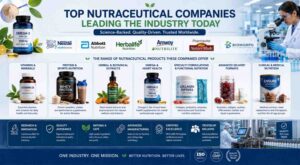
The Range of Nutraceutical Products These Companies Offer
One reason the category keeps growing is sheer variety. The best companies cover several formats and needs, letting a customer or brand find the right fit rather than settling for a compromise.
Dietary supplements and vitamins
This is the heartland of the industry — the capsules, tablets, softgels, and gummies most people picture first. It spans single-nutrient staples like vitamin D, C, and B12, plus minerals such as magnesium, zinc, and iron, alongside combination multivitamins tailored for men, women, children, and older adults. Herbal and specialty supplements — ashwagandha, curcumin, probiotics, collagen — round out an ever-expanding shelf of nutraceutical products designed for specific goals.
Functional foods and beverages
Not everything comes in a pill. Functional foods and drinks bake the benefit straight into something you would eat or sip anyway: protein bars, fortified cereals, probiotic yoghurts, greens powders, electrolyte drinks, and wellness shots. These appeal to people who want a health boost without adding another capsule to their morning routine, and functional nutraceutical products now represent one of the fastest-growing frontiers for companies chasing younger, convenience-minded buyers.
Specialised and preventive wellness formulations
The most sophisticated end of the market targets specific life stages and concerns: prenatal nutrition, joint and mobility support, heart and cholesterol formulas, cognitive and mood blends, sleep aids, gut-microbiome products, and sports-recovery stacks. These formulations often carry the deepest research investment because the claims are more specific and the customers more discerning. This is also where formulation talent and clinical backing pay off most visibly, and where leading nutraceutical products truly justify their price.
How to Choose the Right Nutraceutical Partner for Your Business
If you are building a brand rather than just buying a bottle, choosing a manufacturer is one of the highest-stakes decisions you will make. Not all nutraceutical companies make good production partners, and the right one accelerates you while the wrong one can bury a promising idea under quality complaints and delays. Your goal is a manufacturer who can turn your concept into finished nutraceutical products you are proud to put your name on.
Matching a company to your target market
Start with fit, not flattery. A premium clinical brand needs a partner obsessed with research and documentation; a fast-moving trend brand needs speed, flexible minimum order quantities, and eye-catching formats. A company aiming at a specific region needs a manufacturer who understands that market’s regulations and consumer tastes.
Ask yourself who your customer is and what promise you are making to them, then look for nutraceutical companies whose strengths line up with that promise. A manufacturer brilliant at bulk protein powder may be the wrong choice for a boutique herbal line, and vice versa.
Questions to ask before committing
Before you sign anything, get clear, confident answers to questions like these:
- Which certifications do you hold, and can I see current documentation? GMP, WHO-GMP, ISO, and any relevant regional approvals.
- How do you test raw materials and finished products? Look for testing at multiple stages, ideally with third-party verification available.
- What are your minimum order quantities and typical lead times? These make or break a young brand’s cash flow.
- Do you offer formulation support, or only stock formulas? Custom capability matters if you want a differentiated product.
- What packaging, labelling, and compliance support is included? End-to-end partners save enormous time.
- Can you share references or examples of brands you have manufactured for? A confident partner will.
The way a company answers is often as telling as the answers themselves. Hesitation, evasiveness, or pressure to skip steps are all worth noting.
Red flags that signal you should walk away
Some warning signs should end the conversation:
- Vague or missing certifications, or reluctance to provide documentation.
- No testing details — if they cannot explain how they verify potency and purity, assume they do not.
- Prices that seem too good to be true, which usually means corners are being cut somewhere you cannot see.
- Proprietary-blend secrecy used to hide how little active ingredient is actually present.
- Poor communication during courtship, which only worsens once you are locked in.
Among reputable nutraceutical manufacturing companies, none of these should ever appear. When they do, trust the signal and keep looking.
Trends Reshaping the Nutraceutical Space
The industry is not standing still, and the companies that read the shifts early will define the next decade. A few forces stand out.
Personalised nutrition and clean-label demand
The one-size-fits-all multivitamin is giving way to nutrition tailored to the individual — driven by quizzes, wearables, at-home tests, and even DNA data. Alongside this, “clean label” has become non-negotiable for a large slice of buyers: shorter ingredient lists, no unnecessary fillers or artificial colours, and transparent sourcing. Companies that can deliver personalised, honest nutraceutical products will win the loyalty of the most engaged customers.
Sustainability and ingredient traceability
Consumers increasingly want to know where their ingredients came from and what footprint they left behind. Sustainable sourcing, recyclable packaging, ethically harvested botanicals, and verifiable traceability are moving from marketing bonus to baseline expectation. For nutraceutical companies, the ability to answer “where did this come from?” credibly is becoming a competitive edge rather than an afterthought.
How these shifts will reshuffle the leaders
These trends reward agility as much as size. A nimble manufacturer that can produce small, personalised batches, adopt clean-label formulations quickly, and document its supply chain may outmanoeuvre a slower giant in specific niches. Expect the leaderboard to blend established multinationals with focused, tech-savvy challengers — and expect flexible nutraceutical manufacturing companies, capable of turning new ideas into compliant products fast, to become more valuable than ever to the brands riding these waves.
Frequently Asked Questions
What defines a top nutraceutical company?
A top nutraceutical company combines verifiable quality (recognised certifications and multi-stage testing), genuine research behind its formulas, reliable manufacturing that produces consistent results at scale, and honest, transparent communication with customers. Size alone does not define leadership — a smaller, disciplined manufacturer can outperform a larger one on the metrics that actually protect the consumer.
How are nutraceutical products different from regular supplements?
The terms overlap heavily and are often used interchangeably. “Supplement” usually refers to a product that adds nutrients to the diet, while “nutraceutical” emphasises a food-derived ingredient offering a health benefit that may be supported by research. In practice, most quality supplements are nutraceutical products; the meaningful difference lies less in the label and more in the evidence, sourcing, and testing behind a given item.
What should I look for in nutraceutical manufacturing companies?
Prioritise certifications you can verify (GMP, WHO-GMP, ISO), rigorous ingredient and finished-product testing, formulation and custom-development capability, sensible minimum order quantities and lead times, and clear regulatory and packaging support. Strong communication and willingness to share documentation are excellent indicators. The best nutraceutical manufacturing companies make it easy to confirm every claim they make.
Are nutraceutical products regulated for safety?
Yes, but the level of oversight is generally lighter than for prescription medicines and varies by country. Regulations typically cover manufacturing standards, labelling accuracy, and permissible claims, and responsible manufacturers monitor safety after launch. Because pre-market approval is limited in many markets, the manufacturer’s own standards carry extra weight — which is precisely why choosing trustworthy nutraceutical companies matters so much.
Conclusion — Choosing Names You Can Trust
Strip away the packaging and the promises, and the leaders in this industry are separated by a short list of unglamorous virtues: they test what they make, they are honest about what is in the bottle, they manufacture consistently, and they stand behind their claims. Marketing can imitate confidence, but it cannot fake a clean certificate of analysis or a decade of reliable batches.
Whether you are a shopper deciding which nutraceutical products deserve a place in your daily routine, or a founder searching for a manufacturing partner to build a brand on, the same principle applies — look past the loudest voice and toward demonstrable quality. Ask for the documentation, expect transparency, and reward the companies that treat your trust as something to be earned rather than assumed.
If you are ready to turn a wellness idea into a real, shelf-ready product, seek out a partner whose certifications, capabilities, and communication all point the same direction. Names like Biomorph Lifesciences — built on GMP-certified, end-to-end nutraceutical manufacturing — exist precisely to help serious brands do exactly that, without cutting the corners that matter most.
Website: Visit our official website to learn more.
Call Us: 82838 57755
Instagram: Follow us for the latest updates and industry insights.
Facebook: Join our community and stay connected.