Capsule Manufacturer in India: A B2B Guide for Pharma Brands
Are you looking for a capsule manufacturer in India to source pharmaceutical products in bulk or develop medicines under your own brand?
For pharmaceutical marketing companies, wholesalers, distributors, and brand owners, finding the right manufacturing partner is an important commercial decision.
A suitable supplier must offer more than a product quotation. Buyers should evaluate formulation availability, manufacturing permissions, quality controls, minimum order quantities, packaging, labelling, and delivery arrangements.
India has a substantial pharmaceutical manufacturing sector with businesses offering a wide range of dosage forms, including capsules, tablets, oral liquids, and other formulations.
However, not every pharmaceutical manufacturer can produce every type of capsule or support every product requirement.
This guide explains how to evaluate capsule manufacturing options in India and approach a prospective partner with a clear B2B enquiry.
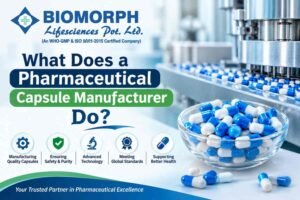
What Does a Pharmaceutical Capsule Manufacturer Do?
A pharmaceutical capsule manufacturer produces medicines in capsule dosage form according to defined formulation specifications and applicable regulatory requirements.
The manufacturer’s responsibilities may include material control, production, in-process testing, packaging, documentation, and quality-related release procedures.
The precise manufacturing process depends on the capsule type and its contents.
Some pharmaceutical businesses operate their own facilities, while others arrange production through appropriately licensed manufacturing units.
For brand owners, the relevant question is whether the actual facility has the required capabilities, permissions, and quality systems for the proposed product.
An experienced commercial coordination partner may also help buyers discuss product selection, packaging, production feasibility, and supply requirements.
Biomorph Lifesciences provides pharmaceutical business solutions, including third-party manufacturing arrangements and an existing product portfolio.
Prospective buyers can explore its pharmaceutical product range before discussing their specific capsule requirements.
Types of Capsules Buyers Should Understand
Capsules are not a single, uniform product category.
Different capsule types can require different manufacturing equipment, formulation expertise, packaging systems, and technical controls.
Understanding these differences helps buyers communicate their requirements accurately.
Hard Capsules
Hard capsules typically consist of two shell sections that are joined after filling.
Depending on the approved product, the fill may contain powder, granules, pellets, or other suitable material.
Hard capsules are used in various pharmaceutical formulations.
Buyers should specify the intended composition, strength, fill characteristics, shell requirements, and packaging.
The manufacturer must confirm whether it is technically and legally able to produce the formulation.
Softgel Capsules
Softgel capsules generally have a sealed, flexible shell surrounding a suitable liquid or semisolid fill.
They require specialized manufacturing processes and formulation expertise.
Softgel production should not be assumed to be available at every facility that manufactures hard capsules.
Businesses considering softgel products should ask about the facility, formulation suitability, applicable approvals, stability information, and packaging requirements.
Modified-Release and Pellet-Based Capsules
Certain formulations are designed to deliver their ingredients according to a specified release profile.
These products may contain coated pellets or other specialized formulations.
Manufacturing them requires appropriate technical capabilities and controls.
A buyer should not assume that a conventional capsule manufacturing line is automatically suitable for a modified-release product.
Product feasibility, specifications, testing, and regulatory requirements must be established before placing an order.
Other Specialized Capsule Requirements
Some products may involve vegetarian shell materials, particular moisture controls, specialized ingredients, or other technical requirements.
The suitability of these options depends on the formulation and relevant regulatory permissions.
The first step is always to identify the exact product rather than requesting “capsule manufacturing” without specifications.
Who Needs Capsule Third-Party Manufacturing?
Capsule manufacturing services can be relevant to different pharmaceutical business models.
Pharmaceutical Marketing Companies
A marketing company may want to introduce medicines under its own brand without investing in a production facility.
In such cases, a manufacturing arrangement may be considered for selected formulations, subject to approval and commercial feasibility.
The company should establish who is responsible for product specifications, artwork, quality documentation, and distribution.
Established Pharma Distributors
A pharmaceutical distributor may already have a customer network and want to expand its capsule portfolio.
The distributor should first decide whether it needs existing branded products or manufacturing under a proposed brand name.
These are different purchasing arrangements.
Private-Label Brand Owners
Businesses planning a private-label product need to evaluate brand-name availability, product permissions, packaging, labelling, order quantities, and the relevant manufacturing agreement.
A new brand name does not by itself establish legal authorization to market a medicine.
Pharmaceutical Businesses Expanding Their Portfolio
Businesses with existing tablet or syrup products may consider capsule formulations where these are commercially and technically appropriate.
However, portfolio expansion should be based on actual market requirements rather than the assumption that a wider catalogue automatically produces higher sales.
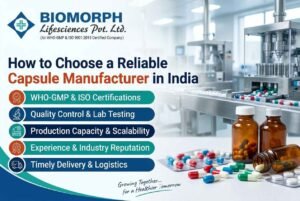
How to Choose a Reliable Capsule Manufacturer in India
Selecting a suitable partner involves reviewing both technical and commercial factors.
1. Verify the Actual Manufacturing Facility
Determine which facility will manufacture the proposed capsules.
Request relevant information about the manufacturing licence, permitted dosage forms, and product-specific authorizations.
Where manufacturing is coordinated through another company, buyers should understand the roles of the marketing company and the actual manufacturing site.
The arrangement should be consistent with applicable legal requirements.
2. Examine Pharmaceutical Quality Systems
Quality systems are essential for consistent capsule production.
Potential buyers should ask about the manufacturer’s controls for:
- Raw material receipt and testing.
- Supplier qualification.
- Material identification and traceability.
- Production process monitoring.
- Finished-product specifications.
- Stability-related information.
- Batch documentation and release.
- Deviation handling and complaints.
For pharmaceutical products, Good Manufacturing Practices form an important part of quality assurance.
The World Health Organization’s GMP guidance explains the importance of consistently producing and controlling medicines to appropriate standards.
A certification claim should be verified for the actual facility and relevant scope.
3. Confirm Formulation Availability
Before discussing a bulk order, share the exact active ingredients, strengths, dosage form, and any required special characteristics.
Ask whether the formulation is already supported by applicable approvals and whether it can be produced at the proposed site.
If the product is not currently available, additional technical or regulatory work may be necessary.
No manufacturer should promise production feasibility before understanding the proposed formulation.
4. Review Packaging and Labelling Capabilities
Packaging affects product identification, storage, traceability, and distribution.
Buyers should discuss the intended pack type, pack size, artwork, applicable warnings, and storage requirements.
The manufacturing arrangement should include procedures for artwork review, approval, and change control.
5. Check Supply and Repeat-Order Feasibility
Production capability should be evaluated beyond the first purchase order.
Ask whether the proposed facility can support planned batch quantities and realistic replenishment schedules.
Clarify how delays, packaging changes, shortages, and quality-related concerns will be communicated.
Consistent coordination can be particularly important when a product is being supplied to multiple distributors.
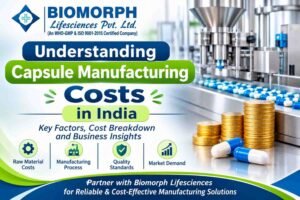
Understanding Capsule Manufacturing Costs in India
Many B2B buyers begin by asking for the manufacturing price.
However, a meaningful quotation requires a clearly defined product.
The cost of producing capsules can vary according to several factors.
Composition and Strength
Different ingredients have different sourcing, formulation, and manufacturing requirements.
The cost cannot be accurately estimated from capsule count alone.
Capsule Type
Hard capsules, softgels, and specialized formulations can require different processes and equipment.
Manufacturing requirements may affect the commercial quotation.
Packaging Materials
Blister packaging, strip packaging, bottles, cartons, labels, and other components may have different costs.
The pack configuration should be finalized before quotations are compared.
Order Quantity
Minimum order quantities depend on the product, manufacturing process, facility, and commercial arrangement.
There is no universal MOQ applicable to every capsule manufacturer in India.
Testing and Documentation
Applicable quality testing, special technical requirements, or regulatory documentation may affect the project cost.
Freight, Taxes, and Other Charges
The complete purchase cost may include additional expenses beyond manufacturing.
A buyer should request an itemized quotation rather than relying on a single unit-price figure.
CAPSULE MANUFACTURING ENQUIRIES
Looking for a Reliable Capsule Manufacturer in India?
Explore pharmaceutical manufacturing opportunities with Biomorph Lifesciences. Connect with our team for capsule manufacturing requirements, product details, bulk orders and business partnership enquiries.
What Information Should You Send for a Capsule Manufacturing Quotation?
A clear enquiry can help the prospective supplier determine whether the project is feasible.
Include the following details:
| Requirement | Information to provide |
|---|---|
| Product composition | Exact active ingredients |
| Strength | Amount of each ingredient per unit |
| Dosage form | Hard capsule, softgel, or another specified form |
| Release requirements | Conventional or specialized release profile |
| Packaging | Proposed pack size and material |
| Brand requirements | Existing or proposed brand name |
| Quantity | Expected initial batch or order volume |
| Target market | State or country where the product will be marketed |
| Documentation | Regulatory or quality documents required |
| Timeline | Desired delivery period, subject to feasibility |
The supplier can then assess product availability, applicable permissions, packaging feasibility, and commercial conditions.
A specific enquiry generally produces a more useful response than asking for the lowest capsule manufacturing rate.
Request a Capsule Manufacturing Quotation
Planning to launch pharmaceutical capsules under your own brand?
Biomorph Lifesciences can discuss capsule-related product requirements and applicable third-party manufacturing arrangements.
Share your formulation, strength, packaging, target market, and estimated quantity.
Explore third-party manufacturing services or contact Biomorph Lifesciences for a product-specific discussion.
Capsule Manufacturing Under Your Own Brand
Developing a pharmaceutical brand requires both commercial planning and compliance-related preparation.
A prospective brand owner should first identify the product it wants to market and establish whether a suitable manufacturing arrangement is available.
The process may involve several stages.
Step 1: Define the Product
Prepare the proposed composition, strength, dosage form, packaging, and target market.
If a specific product is already sold in the market, establish the relevant approved specifications rather than assuming an identical-looking formulation can automatically be manufactured.
Step 2: Check Technical and Regulatory Feasibility
The proposed manufacturing partner should identify whether the facility holds suitable licences and whether the product can be manufactured under the applicable rules.
Specialized formulations may involve additional evaluation.
Step 3: Discuss Branding and Packaging
The brand owner and supplier should establish who is responsible for proposed brand-name checks, artwork, labelling, and final approval.
Packaging should follow applicable pharmaceutical requirements.
Step 4: Review the Manufacturing Quotation
Confirm order quantities, specifications, costs, taxes, payment terms, production planning, and relevant documentation.
Step 5: Finalize Responsibilities
The agreement should identify the responsibilities of the relevant parties for manufacturing, testing, quality records, complaints, and other required activities.
Step 6: Plan Commercial Distribution
Before the product is launched, ensure the intended distribution model complies with the applicable licensing and marketing rules.
A manufacturing agreement is only one part of bringing a pharmaceutical product to market.
For a broader explanation, read Biomorph’s guide to pharmaceutical third-party manufacturing.
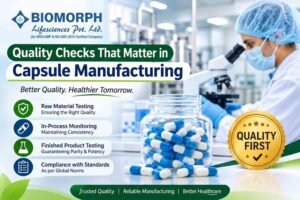
Quality Checks That Matter in Capsule Manufacturing
Capsule quality cannot be evaluated only by appearance.
The testing and manufacturing controls required depend on the product’s specifications.
For applicable formulations, buyers may review whether the manufacturer’s quality system addresses the following areas.
Identity and Strength
The product should contain the intended ingredients according to its approved specifications.
Content Uniformity
Where applicable, testing should evaluate whether the dosage units meet the relevant uniformity requirements.
Disintegration and Dissolution
These tests may be required under product-specific specifications to assess the dosage form’s performance.
Moisture and Stability
Some capsule formulations may be sensitive to environmental conditions.
Storage, packaging, and stability requirements should be established according to the particular product.
Packaging Integrity
Finished packaging must be suitable for the product and consistent with approved requirements.
Batch Records and Traceability
Appropriate documentation supports the ability to trace the manufacture and distribution of specific batches.
Buyers should discuss these topics with a qualified technical or quality representative rather than treating a general checklist as a substitute for product-specific assessment.
Common Mistakes Buyers Should Avoid
A sourcing decision can become difficult when key information is missing.
Comparing Different Products as Though They Are Identical
Two capsule quotations may differ because of ingredients, strength, specifications, packaging, or order quantity.
Confirm the technical details before comparing prices.
Ignoring the Manufacturing Source
A trading or marketing company may coordinate production, but buyers should still identify and verify the actual facility.
Assuming Every Capsule Type Is Available
Hard capsules, softgels, and modified-release products may require different facilities and permissions.
Ask about the exact proposed dosage form.
Focusing Only on Minimum Price
Commercially attractive pricing is useful, but quality documentation, supply reliability, and transparent terms must also be considered.
Launching Without a Repeat-Order Plan
A new product may require sustained availability.
Discuss expected replenishment, reasonable inventory buffers, and communication procedures before the initial purchase.
Why Enquire With Biomorph Lifesciences?
Biomorph Lifesciences Pvt. Ltd. offers pharmaceutical business solutions that include an existing product portfolio and third-party manufacturing-related services.

The company’s published catalogue contains capsule products alongside tablets, syrups, injections, and other formulations.
Prospective buyers can discuss whether a suitable manufacturing or product-supply arrangement is available for their proposed capsule requirements.
A useful initial discussion should cover:
- Exact composition and strength.
- Intended capsule type.
- Proposed packaging.
- Quantity and order frequency.
- Brand and target market requirements.
- Required documentation.
- Commercial feasibility.
Availability, approvals, manufacturing source, and final terms should be confirmed for each product.
Frequently Asked Questions
1. How do I find a capsule manufacturer in India?
Identify your required formulation and capsule type, then evaluate potential suppliers based on manufacturing permissions, technical capability, quality systems, packaging, MOQ, and supply arrangements.
2. Does Biomorph Lifesciences offer capsule manufacturing services?
Biomorph publishes capsule products and third-party manufacturing services. Buyers can enquire about whether an appropriate manufacturing arrangement is available for their specific formulation and requirements.
3. What is the MOQ for capsule manufacturing?
MOQ depends on the product, manufacturing process, packaging, facility, and commercial terms. Request a product-specific quotation.
4. Can I launch capsules under my own pharmaceutical brand?
Own-brand manufacturing arrangements may be possible where the necessary permissions, technical requirements, agreements, and commercial conditions can be met.
5. Are hard capsules and softgels manufactured using the same process?
No. They generally involve different manufacturing methods and equipment. The exact capabilities of the proposed manufacturing facility must be verified.
Conclusion
Selecting a capsule manufacturer in India requires careful evaluation of formulation capabilities, manufacturing licences, quality systems, packaging, documentation, pricing, and long-term supply requirements.
For pharmaceutical marketing companies, the ideal partner is not simply the supplier offering the lowest quotation. It is the one whose actual manufacturing capabilities and commercial arrangements match the product’s requirements.
Biomorph Lifesciences welcomes enquiries from pharmaceutical distributors, marketing companies, brand owners, and other eligible B2B buyers.
Discuss Your Capsule Manufacturing Requirement
Need capsules for your pharmaceutical brand or distribution business?
Send Biomorph Lifesciences your required composition, strength, capsule type, packaging, and expected order quantity.
Contact Biomorph Lifesciences to discuss feasibility, product availability, and a suitable commercial quotation.
Phone: +91 82838 57755
Product availability, technical feasibility, licensing, and manufacturing arrangements are subject to verification and agreement.
PHARMA BUSINESS & SOURCING PARTNERSHIP
Need Quality Capsules for Your Pharmaceutical Business?
Choose the right manufacturing partner for your pharmaceutical business. Biomorph Lifesciences offers pharma business support and product sourcing opportunities for distributors, marketers and business partners looking to expand their product portfolio.