Finding a reliable injection manufacturer in India is an important decision for pharmaceutical marketing companies, medicine distributors, wholesalers, and businesses planning to launch injectable products under their own brands.
Unlike conventional oral medicines, injectable formulations require specialized production environments, strict quality controls, and careful handling throughout manufacturing and distribution.
For pharmaceutical businesses, choosing a suitable supplier involves more than comparing product prices. Manufacturing permissions, sterile production capabilities, packaging specifications, quality documentation, minimum order quantities, and delivery arrangements all deserve attention.
Biomorph Lifesciences Pvt. Ltd. offers pharmaceutical product and business-supply solutions, including opportunities to discuss injectable medicines and third-party manufacturing arrangements.
This guide explains how business buyers can identify suitable injectable products, evaluate manufacturers, understand commercial requirements, and prepare a manufacturing or bulk-supply enquiry.
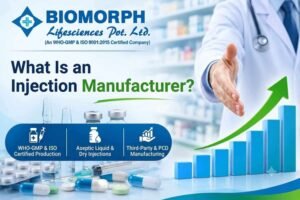
What Is an Injection Manufacturer?
An injection manufacturer is a pharmaceutical manufacturing organization involved in producing injectable medicines according to applicable regulatory requirements and approved product specifications.
Injectable medicines are administered through appropriate routes under healthcare-professional supervision. Their manufacturing requirements can differ considerably from those of tablets, capsules, and oral liquids.
For this reason, pharmaceutical businesses should confirm that the actual manufacturing facility has the relevant permissions, equipment, environmental controls, and quality systems for the proposed product.
An injection manufacturer may be involved in activities such as:
- Raw material identification and quality testing.
- Preparation of pharmaceutical formulations.
- Sterile manufacturing or applicable sterilization processes.
- Filling and sealing of containers.
- In-process testing and environmental monitoring.
- Finished-product quality testing.
- Labelling and packaging.
- Batch documentation and quality release.
The exact process depends on the dosage form, formulation, and approved manufacturing method.
Some pharmaceutical marketing companies arrange production through external licensed facilities rather than operating their own injectable manufacturing plants.
In such arrangements, buyers should identify both the commercial supplier and the actual manufacturing site.
Types of Injectable Medicines Available in India
Pharmaceutical manufacturers may specialize in different injectable dosage forms.
Understanding the differences helps buyers choose a supplier whose capabilities match their requirements.
1. Dry Powder Injections
Dry powder injections are supplied as solid pharmaceutical preparations that may require reconstitution with an appropriate diluent before administration, according to the approved product instructions.
These formulations can have specific requirements concerning manufacturing, packaging integrity, moisture control, and stability.
Business buyers should confirm the required composition, strength, vial presentation, compatible diluent arrangements where applicable, and product documentation.
Dry powder production capabilities must be verified at the specific manufacturing facility.
2. Liquid Injections
Liquid injections contain a pharmaceutical ingredient in a suitable liquid formulation.
Depending on the medicine, the product may be supplied in vials, ampoules, or another approved container system.
The manufacturer should provide appropriate information about the formulation, container closure, labelled storage conditions, and applicable quality testing.
3. Single-Dose and Multidose Vials
Some injectable medicines are presented in single-dose containers, while others may be authorized in multidose presentations.
The appropriate presentation depends on the specific product, its formulation, approved use, and regulatory requirements.
Buyers should not choose between these formats solely on packaging cost.
4. Specialized Injectable Formulations
Certain injectable products require specialized manufacturing technologies, handling procedures, or storage environments.
These may include products with particular stability requirements or sterile formulations produced using specialized processes.
Not every injection manufacturer has the facility or permissions to produce these products.
Before placing an order, establish whether the proposed manufacturing site can handle the exact formulation.
Who Needs an Injection Manufacturer in India?
Injection manufacturing and supply arrangements can serve several pharmaceutical business models.
Pharmaceutical Marketing Companies
A pharmaceutical marketing company may want to introduce injectable medicines into its portfolio without establishing its own production facility.
Under an appropriate third-party manufacturing arrangement, production can be coordinated with a suitably licensed manufacturer.
The brand owner and manufacturing partner must clearly define their regulatory, quality, and commercial responsibilities.
PCD Pharma Franchise Distributors
Existing pharmaceutical distributors may want to add injectable medicines to their available product range.
Before doing so, they should review customer requirements, storage conditions, product documentation, and the permissions required for their business activities.
Biomorph Lifesciences provides information about its pharmaceutical product portfolio, including injectable product listings that can be discussed with its team.
Pharmaceutical Wholesalers
Wholesalers purchasing medicines in bulk generally require clear product specifications, batch information, commercial pricing, and appropriate documentation.
The suitability of a supplier depends on the exact products required and the wholesaler’s ability to store and distribute them in compliance with applicable conditions.
Own-Brand Pharmaceutical Businesses
A company developing its own brand may seek an injectable manufacturing arrangement involving an approved formulation, proposed packaging, and agreed commercial quantities.
Such projects require careful assessment of product permissions, branding, labelling, and manufacturing feasibility.
How to Choose a Reliable Injection Manufacturer in India
Selecting a suitable manufacturing partner requires a systematic evaluation.
A professional website or extensive product catalogue alone is not sufficient evidence of manufacturing capability.
1. Verify Manufacturing Licences
Before finalizing a supplier, identify the actual facility that will manufacture the proposed injectable medicine.
Confirm the applicable manufacturing licences and relevant product permissions.
A facility approved for one product or dosage form should not automatically be assumed suitable for another.
Pharmaceutical buyers can refer to the Central Drugs Standard Control Organization (CDSCO) for regulatory information and relevant notifications.
2. Evaluate Sterile Manufacturing Standards
Sterile pharmaceutical manufacturing requires appropriate systems to control contamination risks.
The World Health Organization publishes specific Good Manufacturing Practices guidance for sterile pharmaceutical products.
Depending on the manufacturing process, relevant controls may include classified production areas, environmental monitoring, personnel training, sterilization procedures, contamination-control strategies, and suitable quality systems.
Buyers should request evidence relevant to the actual site and product.
Claims about GMP compliance should be supported by appropriate, current documentation rather than marketing statements alone.
3. Review Quality Testing and Documentation
A manufacturer should be able to explain its quality-control arrangements.
Depending on the product and applicable specifications, the review may include:
- Product identity and strength.
- Sterility-related requirements.
- Bacterial endotoxin testing, where applicable.
- Particulate-matter requirements.
- Container-closure integrity.
- Stability-related information.
- Batch manufacturing records.
- Finished-product release procedures.
The required tests vary by product.
Buyers should consult qualified quality or regulatory personnel when reviewing technical records.
4. Confirm Packaging Capabilities
Injectable packaging is an important part of product protection and identification.
A supplier may offer different presentations depending on the formulation and approved manufacturing arrangement.
Ask about:
- Vial or ampoule presentation.
- Container size and material.
- Closure and seal requirements.
- Secondary carton specifications.
- Product labelling.
- Batch identification.
- Transport packaging.
- Relevant storage conditions.
Any proposed branding or packaging change should be evaluated for compliance and technical suitability.
5. Assess Production and Supply Capacity
An appropriate manufacturing partner should be able to discuss realistic production and supply arrangements.
Ask about expected batch quantities, manufacturing lead times, quality-release timelines, packaging procurement, and dispatch procedures.
A written agreement should address how delays and quality-related issues are communicated.
The ability to coordinate repeat orders can be important for pharmaceutical marketing companies managing distribution networks.
Third-Party Injection Manufacturing in India
Third-party injection manufacturing allows a pharmaceutical business to arrange production through an external facility instead of building and operating its own sterile manufacturing plant.
This model may be suitable for companies expanding their product portfolios or developing medicines under a proposed brand.
However, it involves responsibilities beyond purchasing finished goods.
How the Process Works
Step 1: Product selection
The buyer identifies the required injectable composition, strength, dosage form, and intended market.
Step 2: Manufacturing feasibility
The proposed supplier evaluates whether a suitable licensed facility and applicable product permissions are available.
Step 3: Packaging discussion
Both parties clarify container requirements, labelling, cartons, and artwork responsibilities.
Step 4: Commercial quotation
The manufacturing arrangement is reviewed for order quantity, price, payment terms, applicable taxes, and delivery requirements.
Step 5: Documentation and agreement
Responsibilities for product specifications, quality-related activities, commercial terms, and applicable regulatory obligations are documented.
Step 6: Manufacturing and supply
Production and batch release proceed according to the relevant approved specifications and quality systems.
The process and timelines will vary depending on the formulation.
Businesses exploring this model can read more about third-party manufacturing for pharmaceutical business growth.
What Influences Injection Manufacturing Costs?
The price of injectable medicines depends on several technical and commercial factors.
There is no universal manufacturing rate applicable to all injectable formulations.
Product Composition
Different pharmaceutical ingredients have different sourcing, formulation, stability, and manufacturing requirements.
A quotation must be based on the exact product.
Dosage Form
Dry powder injections and liquid injectable formulations may require different processes, equipment, and packaging systems.
Specialized production requirements can influence cost and feasibility.
Manufacturing Quantity
Minimum order quantities may depend on the product, available manufacturing capacity, packaging materials, and commercial arrangement.
A larger order may change certain per-unit costs, but it also increases working-capital and inventory exposure.
Packaging Requirements
Container type, vial size, seals, labels, cartons, and other packaging components can affect the quotation.
Testing and Regulatory Requirements
Applicable quality-control procedures, documentation, and product-specific requirements form part of the manufacturing arrangement.
Freight and Storage Conditions
Transportation expenses depend on the destination, packaging, shipment size, and any special handling requirements.
Not all injectable products require refrigeration. The relevant storage conditions must be established from the approved product information.
How to Request Accurate Pricing
For a useful quotation, share the exact composition, strength, dosage form, pack configuration, required quantity, and delivery location.
This allows the supplier to assess the commercial requirement without relying on a generic price estimate.
Request an Injectable Manufacturing Quotation
Looking for an injection manufacturer or bulk injectable medicine supplier in India?
Biomorph Lifesciences welcomes enquiries from pharmaceutical marketing companies, authorized wholesalers, distributors, and businesses exploring own-brand manufacturing.
Share your required composition, strength, vial or ampoule presentation, expected quantity, and delivery location.
Discuss Third-Party Manufacturing with Biomorph
Product availability, manufacturing feasibility, and commercial terms will be confirmed according to the specific requirement.
What Documents Should Pharmaceutical Buyers Request?
Documentation is a significant consideration when purchasing injectable medicines or establishing manufacturing partnerships.
The appropriate records depend on the product, buyer, and transaction.
A buyer may need to discuss the following information.
| Document or information | Why it matters |
|---|---|
| Manufacturing licence | Helps verify the authorization of the actual facility |
| Product permission | Establishes the relevant approved manufacturing status |
| Product specifications | Defines required product characteristics |
| Certificate of Analysis | Provides relevant batch-testing information |
| Packaging specifications | Identifies agreed container and labelling requirements |
| Batch-related records | Supports quality review and traceability |
| Stability information | Supports evaluation of approved storage and shelf-life requirements |
| Commercial agreement | Clarifies pricing, delivery, and responsibilities |
Not every document is automatically supplied to every buyer, and some manufacturing records may contain confidential information.
The required access and exchange arrangements should be determined through applicable law, contractual obligations, and quality agreements.
A responsible supplier should explain which documents are available and how relevant information can be reviewed.
Dry Powder Injection Manufacturing vs Liquid Injection Manufacturing
Both are injectable dosage forms, but they can involve different technical requirements.
| Factor | Dry powder injection | Liquid injection |
|---|---|---|
| Product presentation | Solid preparation | Liquid formulation |
| Preparation before use | May require reconstitution | Depends on the product |
| Packaging | Often suitable vials | Vials, ampoules, or other approved systems |
| Manufacturing process | Product-specific sterile manufacturing requirements | Product-specific sterile manufacturing requirements |
| Stability | Depends on formulation | Depends on formulation |
| Commercial requirements | Composition, vial specification, quantity | Composition, container format, quantity |
Neither type should be considered automatically superior.
The correct choice depends on the medicine, approved presentation, intended use, and applicable manufacturing requirements.
Injectable Medicine Supply for PCD Pharma Franchise Businesses
A pharmaceutical distributor looking for an injection supplier may need finished branded medicines rather than manufacturing services.
This is an important distinction.
A distributor should specify whether it wants to:
- Purchase existing pharmaceutical brands for authorized distribution.
- Explore a PCD franchise arrangement.
- Arrange manufacturing under its own proposed brand.
Each option involves different commercial and regulatory requirements.
For an existing distribution business, the main considerations may be product availability, pricing, pack specifications, order quantities, delivery conditions, and repeat-supply arrangements.
For an own-brand manufacturing business, additional discussions may involve product permissions, manufacturing agreements, packaging approvals, and the responsibilities of the marketing company.
Biomorph Lifesciences publishes individual injectable product listings, including Ceforf-S 375 (Ceftriaxone and Sulbactam).
Business buyers can use product listings to prepare composition-specific enquiries. Current availability, manufacturing source, specifications, and quotation terms must be confirmed.
How to Build an Injectable Product Portfolio
Before expanding into injectable medicines, pharmaceutical businesses should evaluate their operational capabilities and target market.
Study the Intended Distribution Network
Identify the types of authorized pharmaceutical customers the business intends to serve.
Assess their procurement requirements rather than selecting products based only on promotional claims.
Shortlist Suitable Products
Create a list of required formulations and strengths.
Review the product’s approved status, storage conditions, packaging, and commercial suitability.
Assess Storage and Transportation
Injectable medicines should be handled under the conditions specified for the particular product.
The business should be able to maintain the required storage and transport arrangements.
Review Working Capital
Calculate the likely initial order cost, transport expenses, operating reserve, and realistic replenishment requirements.
Avoid purchasing an extensive range without sufficient market and inventory planning.
Monitor Supplier Performance
Track the supplier’s response time, documentation, delivery performance, and handling of relevant quality-related concerns.
These operational factors can affect the reliability of a pharmaceutical distribution business.
Common Mistakes When Selecting an Injection Manufacturer
Choosing an injectable manufacturing partner without sufficient verification can create avoidable commercial and compliance risks.
Mistake 1: Selecting Only by Price
A low quotation is not sufficient evidence that a supplier is suitable.
Buyers should compare product specifications, manufacturing arrangements, documentation, and total procurement costs.
Mistake 2: Ignoring the Actual Manufacturing Facility
Some companies coordinate orders through other manufacturing sites.
Buyers should establish which licensed facility will produce the medicine and verify the relevant permissions.
Mistake 3: Assuming All Injectable Products Use the Same Manufacturing Process
Different injectable formulations may require different equipment, environmental controls, testing, and approvals.
The proposed facility should be evaluated for the actual product.
Mistake 4: Overlooking Product Storage Requirements
Some formulations require particular temperature or handling conditions.
Failure to understand those requirements can create distribution and quality concerns.
Mistake 5: Making an Unclear Enquiry
A request for “injections in bulk” may not provide enough information for the supplier to prepare a useful quotation.
Include the exact formulation, strength, pack size, and proposed quantity.
Mistake 6: Ignoring Repeat-Supply Planning
A business should assess whether the supplier can support realistic replenishment requirements.
Manufacturing lead times and product availability must be discussed before making commercial commitments.
Why Enquire with Biomorph Lifesciences?
Biomorph Lifesciences Pvt. Ltd. is an India-based pharmaceutical company headquartered in Chandigarh.
The company publishes a portfolio covering multiple pharmaceutical dosage forms, including injectable medicines, tablets, capsules, syrups, dry syrups, and other formulations.
It also provides information about third-party manufacturing and pharmaceutical franchise business opportunities.
For businesses looking for injectable products, Biomorph offers a starting point for discussing available formulations and suitable commercial arrangements.
Product-Based Enquiries
Distributors and wholesalers can review the published catalogue and request details about relevant injectable medicines.
Third-Party Manufacturing Discussions
Pharmaceutical marketing companies can submit product-specific manufacturing requirements, including proposed branding, formulation, packaging, and quantity.
Commercial Supply Enquiries
Bulk buyers can discuss available products, quotations, documentation requirements, and order arrangements.
Product Portfolio Expansion
Businesses already working in pharmaceutical distribution can assess whether selected injectable products are suitable for their existing operations.
All such arrangements remain subject to product availability, applicable permissions, manufacturing feasibility, and agreed terms.
For a broader overview of the outsourcing model, read Biomorph’s pharmaceutical third-party manufacturing guide.
Frequently Asked Questions
1. How can I find an injection manufacturer in India?
Start by specifying the medicine composition, strength, dosage form, packaging, and required quantity. Then evaluate suppliers based on relevant manufacturing permissions, sterile manufacturing capabilities, quality documentation, and commercial terms.
2. Does Biomorph Lifesciences offer injectable products?
Biomorph Lifesciences publishes injectable medicines in its product catalogue. Buyers can enquire about available formulations, applicable third-party manufacturing arrangements, and bulk-supply requirements.
3. What is the minimum order quantity for injection manufacturing?
MOQ varies according to the formulation, manufacturer, packaging, and commercial arrangement. A product-specific quotation is required to establish the applicable minimum quantity.
4. Can injectable medicines be manufactured under my own brand?
Own-brand manufacturing may be possible through a suitable licensed manufacturing arrangement, subject to product permissions, quality requirements, packaging compliance, and agreed responsibilities.
5. What should I check before purchasing injections in bulk?
Verify the product details, actual manufacturing source, relevant licences, quality documentation, storage requirements, packaging, delivery conditions, and the seller’s applicable permissions.
Conclusion
Selecting an injection manufacturer in India requires careful consideration of manufacturing capability, product permissions, sterile quality systems, packaging, minimum order quantities, and commercial reliability.
For pharmaceutical marketing companies and authorized distributors, a suitable manufacturing or supply partner should provide clear product information and allow buyers to evaluate the requirements relevant to their business.
Rather than focusing only on low prices or large product catalogues, buyers should prioritize verified documentation, product suitability, transparent quotations, and dependable communication.
Biomorph Lifesciences offers pharmaceutical business solutions for companies exploring injectable medicine supply, PCD franchise opportunities, and applicable third-party manufacturing arrangements.
Get a Quote for Injectable Medicines
Looking for injectable products for bulk supply or your own pharmaceutical brand?
Send Biomorph Lifesciences your product requirements to discuss suitable arrangements.
Include:
- Medicine composition and strength.
- Dry powder or liquid injection requirement.
- Preferred vial or ampoule presentation.
- Proposed brand requirements, if applicable.
- Estimated order quantity.
- Delivery location.
- Business type and applicable licence information.
Contact Biomorph Lifesciences for an Injectable Product Enquiry
Phone: +91 82838 57755
Product and manufacturing availability, pricing, documentation, and commercial terms are subject to verification and confirmation.