Picture yourself at the pharmacy counter. You hand over a prescription, and the pharmacist looks up with a simple question: “Do you want the regular one, or is the cheaper version fine?” Suddenly you’re holding two boxes that treat the exact same problem, yet one costs a fraction of the other. It’s an oddly stressful little moment. Is the low-priced option a shortcut that quietly cuts corners, or are you just being handed a smarter way to spend? That single decision sits at the centre of the whole generic medicine vs branded medicine conversation, and most people make the call based on gut feeling rather than facts. This guide is here to fix that. We’ll walk through what actually separates the two, where your money really goes, and how to choose with confidence instead of second-guessing yourself on the way home.
What “Generic” and “Branded” Actually Mean
Before you can compare anything fairly, you need to know what these two labels stand for. The words get thrown around so often that they’ve lost their meaning for a lot of people. So let’s strip away the marketing and look at what each term genuinely describes.
How a Branded Medicine Earns Its Name
When a pharmaceutical company invents a brand-new drug, it spends years developing the molecule, testing it, and proving it works. In return, it receives a patent — a legal head start that lets it sell that discovery exclusively for a set period. During those years, the company markets the drug under a memorable trademarked name, and that’s what turns it into one of the branded medicines you see advertised and stocked front and centre.
The brand name isn’t just a label; it’s tied to the reputation, packaging, and marketing muscle the originator built around it. That recognition is a big part of why branded medicines feel familiar and reassuring to patients who have taken them for years.
Where Generics Come In
A patent doesn’t last forever. Once it expires, the formula is no longer locked behind one company’s door, and other approved manufacturers are free to produce the very same drug. These versions are called generics. They contain the identical active ingredient as the original, but they skip the brand name and the premium that comes with it.
Think of it like a recipe becoming public: the dish is the same, but now several trusted kitchens can cook it. This is the exact point where the generic medicine vs branded medicine choice is born, because for the first time patients get two routes to the same treatment — the established branded medicines, or a lower-cost generic that mirrors them.
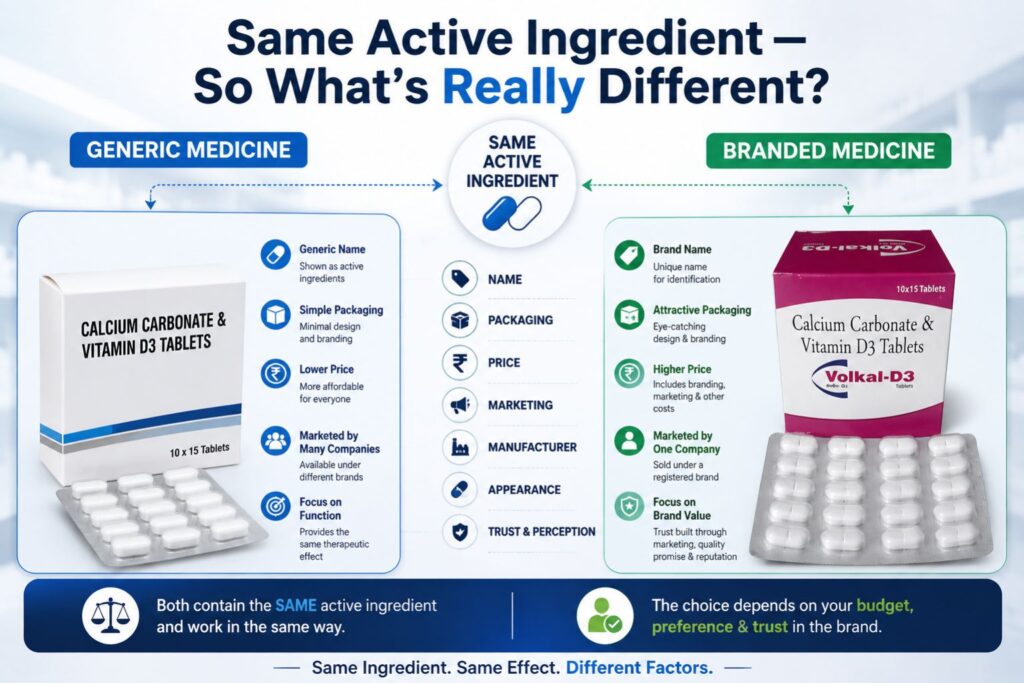
Same Active Ingredient — So What’s Really Different?
Here’s the part that surprises people most. In a genuine generic medicine vs branded medicine comparison, the working component inside both pills is the same molecule, at the same strength, in the same dose. If a branded tablet delivers 500 mg of a compound, its generic counterpart delivers that identical 500 mg. So if the medicine at the core is the same, where does the difference actually live?
Bioequivalence in Plain Language
Regulators don’t just take a manufacturer’s word for it. Before a generic reaches your pharmacy, it has to prove “bioequivalence” — a slightly technical term with a simple meaning. It means the generic has to enter your bloodstream and act in your body at essentially the same rate and to the same degree as the original branded pharmaceutical products it copies.
In practice, your body shouldn’t be able to tell the two apart in any way that matters to your health. This testing is the safety net that keeps generics honest and stops them from being a watered-down substitute for branded medicines.
The Parts That Can Differ
So something must be different, right? Yes — just not the part doing the healing. The differences sit in the supporting cast: the inactive fillers that give a tablet its bulk, the coating that helps it slide down, and cosmetic details like colour, shape, and packaging.
A generic might be round where the branded medicines are oval, or blue instead of white. These choices exist because the original design is protected, not because quality was sacrificed. For the overwhelming majority of patients, none of these surface details change how well the treatment works.
Why the Price Gap Is So Wide
If the medicine inside is identical, the obvious suspicion creeps in: “If it’s this much cheaper, something must be wrong with it.” It’s a fair worry, and it deserves a straight answer. The price gap isn’t a quality gap — it’s a timeline gap. Understanding where the cost comes from makes the whole generic medicine vs branded medicine debate a lot clearer.
The Cost of Being First
Inventing a drug is brutally expensive. The originator pours money into years of research, rounds of clinical trials, regulatory paperwork, and failed experiments that never make it to market. On top of that sits a heavy advertising and awareness budget.
All of those costs get folded into the price of branded medicines, because that first company has to recover the enormous investment it made to bring the drug into existence. You’re not only paying for the pill — you’re paying for the discovery behind it.
Why Generics Cost Less Without Cutting Corners
Generic makers walk in after the hard, costly groundwork is already done. They don’t repeat the original research, they don’t fund massive marketing campaigns, and they don’t carry the risk of inventing something from scratch. Several manufacturers can also produce the same drug at once, and that competition naturally pushes prices down.
So the lower cost comes from skipping duplicated expenses — not from using cheaper science. It’s a common misconception that a smaller price tag signals a weaker product, when the real story is simply a leaner path to the same result that branded medicines deliver.
The Trust Question — Are Generics Really as Safe?
This is the wall most people hit. Even after hearing that the ingredient is identical and the price gap is explainable, there’s a lingering “yes, but is it safe?” Let’s meet that head on, because trust is what actually decides whether someone switches or sticks with branded medicines out of habit.
The Approval and Quality Checks Behind Every Generic
Generics aren’t waved through on a formality. In India, they answer to the CDSCO, and comparable watchdogs like the FDA hold the same line elsewhere. On top of regulatory approval, reputable manufacturers operate under strict certifications such as WHO-GMP, which governs how a medicine is made, tested, and packaged.
These standards apply to the facility, the process, and the final product alike. In other words, a quality-assured generic is held to the same manufacturing bar as the branded medicines sitting beside it on the shelf — not a lower one.
Common Myths Worth Unlearning
A lot of the hesitation around generics comes from stories rather than science. A few of the most stubborn myths are worth clearing up:
- “Generics are weaker.” They carry the same active ingredient at the same strength as branded medicines, so the potency is not reduced.
- “They take longer to work.” Bioequivalence testing exists specifically to confirm they act within the same window as the original.
- “Cheaper means lower quality.” The lower price reflects skipped research and marketing costs, not compromised ingredients.
Once you separate the rumours from the regulations, generics stop looking like a gamble and start looking like an informed choice.
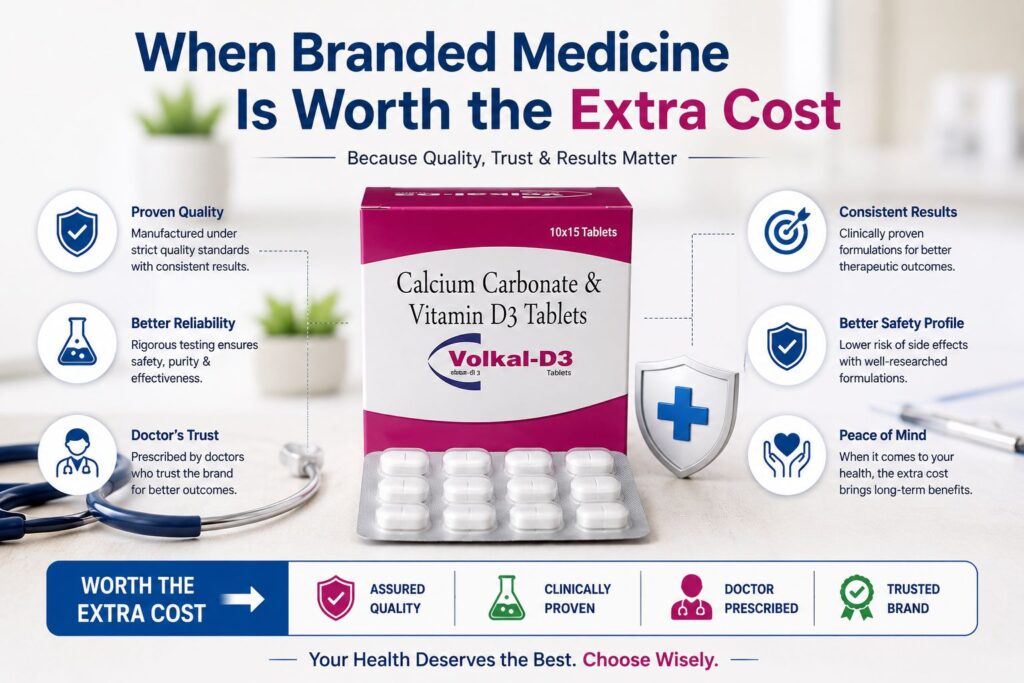
When Branded Medicine Is Worth the Extra Cost
Now for some honesty in the other direction. Generics win a lot of the time, but not every time — and pretending otherwise would do you a disservice. There are real situations where paying more for branded medicines is the wiser move, and knowing them is part of choosing well.
Narrow-Therapeutic-Index Drugs and Sensitive Conditions
Some medicines have almost no margin for error. With these “narrow-therapeutic-index” drugs, even a tiny variation in how the body absorbs the dose can matter — think certain blood thinners, thyroid treatments, or anti-seizure medications.
In these cases, the consistency and long track record of branded medicines can offer valuable peace of mind, and many doctors prefer patients stay on one steady version rather than switching back and forth. Here, the benefit of branded medicines isn’t marketing — it’s predictability where predictability counts most.
Situations Where Familiarity and Reassurance Count
Medicine isn’t purely chemical; confidence plays a role in how a patient feels about their treatment. Someone managing a chronic condition for years may respond better, mentally and practically, to the branded medicines they already know and trust.
A specific formulation, a particular release mechanism, or simply a doctor’s considered preference can all tip the scale toward the original. For these patients, the reassurance that comes with established branded medicines is a genuine benefit, not an indulgence — and that comfort can support better adherence to the treatment plan.
When Choosing Generic Is the Smarter Move
Flip the coin and there’s an equally strong case for generics — often a stronger one for everyday life. This is where the savings side of the generic medicine vs branded medicine question really earns its place.
Everyday and Long-Term Prescriptions
For routine, ongoing treatments — the kind you refill month after month for blood pressure, cholesterol, or diabetes — the maths adds up fast. A modest saving per box turns into a serious sum over a year, and an even bigger one over a lifetime of prescriptions.
When the generic matches branded medicines in ingredient and effect, choosing it on a long-term prescription simply keeps more money in your pocket without changing your outcome.
Budget-Conscious Care Without Sacrificing Outcomes
Cost shouldn’t decide who gets to stay well, and generics help close that gap. They let clinics treat more patients, and they let families stretch a health budget further without downgrading the actual treatment. When quality-assured generics deliver the same result as branded medicines for a fraction of the price, opting for them isn’t settling — it’s spending intelligently on care that works.
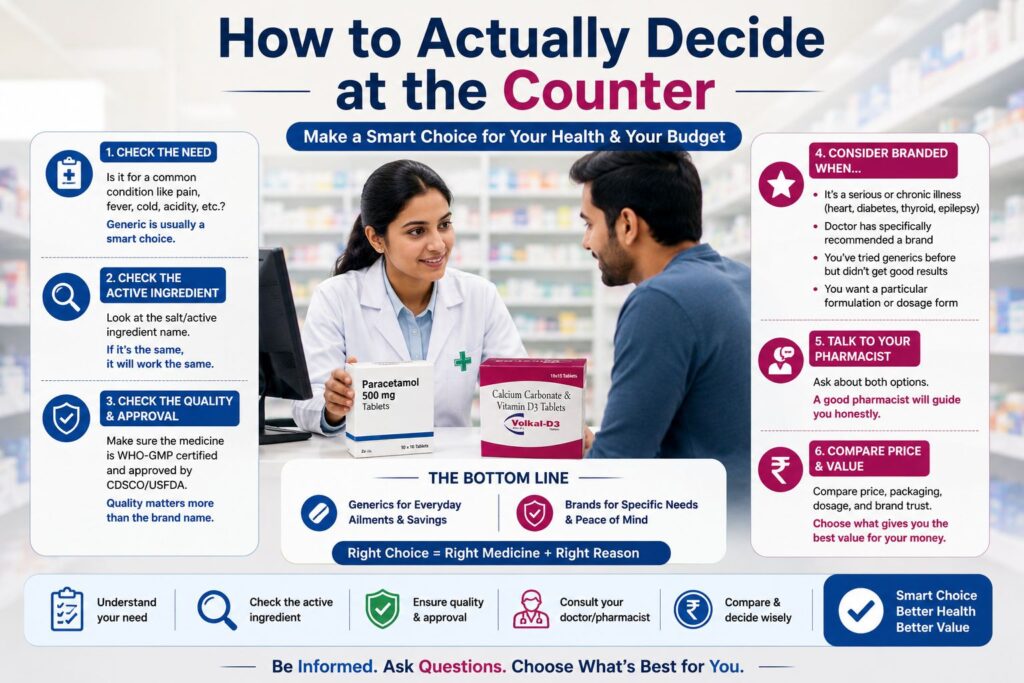
How to Actually Decide at the Counter
All the theory in the world doesn’t help if you freeze up when the pharmacist asks the question. So let’s turn it into a simple, repeatable decision you can make in seconds — which was the whole promise behind “which one to pick?”
Questions to Ask Your Doctor or Pharmacist
You don’t need a pharmacology degree to choose wisely — you just need to ask the right things. A few useful prompts:
- “Is there an approved generic for this, and is it right for my condition?”
- “Is this one of those drugs where I should stick with a single consistent version?”
- “Will switching between generics and branded medicines cause any issues for me?”
- “If cost is a concern, what’s the safest way to save here?”
These questions hand the decision back to someone who knows your medical history, which is exactly where it belongs.
How to Read What’s on the Label
The secret to comparing fairly is ignoring the big brand name and finding the active ingredient, usually printed in smaller text nearby. That ingredient — and its strength in milligrams — is the true identity of the drug. If a generic lists the same active ingredient at the same strength as the branded medicines you were prescribed, you’re looking at the same treatment in different packaging. Learning to spot that one line turns you from a passive buyer into a confident one.
The Bottom Line — Picking What’s Right for You
So, after weighing it all, where does the generic medicine vs branded medicine question actually land? For most people, most of the time, a quality-assured generic delivers the same result as the original for noticeably less money — and there’s no medical reason to pay extra out of habit.
At the same time, branded medicines keep a rightful place on the shelf for sensitive conditions, delicate dosing, and patients whose stability or peace of mind depends on staying with a version they trust. The real lesson is that the smarter choice isn’t decided by the label at all. It’s decided by your specific condition, your doctor’s guidance, and what your situation genuinely needs. Get that right, and both generics and branded medicines become tools you can use with confidence rather than choices you second-guess.
Frequently Asked Questions
Do generic and branded medicines work the same way? In the vast majority of cases, yes. A generic carries the identical active ingredient at the same strength as its branded counterpart and must pass bioequivalence testing, meaning it acts in your body in essentially the same way as the branded medicines it copies.
Are cheaper generics lower in quality? No. The lower price reflects skipped research, trial, and marketing costs — not cheaper ingredients. Approved generics are manufactured under the same quality standards, such as WHO-GMP, that govern branded medicines.
Can I switch from a branded medicine to a generic mid-treatment? Often you can, but it’s worth a quick word with your doctor first — especially for sensitive drugs where consistency matters. For most routine prescriptions, moving from branded medicines to an approved generic is straightforward.
Why do doctors sometimes insist on branded pharmaceutical products? Usually because the drug has a narrow safety margin, or because a patient is stable and switching could introduce unnecessary variables. In those specific cases, the consistency of branded pharmaceutical products is a genuine clinical advantage rather than a preference.
Website: Click Here
Read More Blogs