Dubai rarely does anything at half speed. In a single generation, it turned a stretch of desert coastline into a place where global trade, tourism, and finance meet, and healthcare has quietly become one of the next big chapters in that story. Behind the gleaming hospitals and the medical tourists flying in for treatment sits a sector that keeps the whole thing running: medicine. The pharmaceutical industry in Dubai has grown from a modest network of importers and distributors into a genuine regional player, and the momentum shows little sign of slowing.
This piece walks through why the city has drawn so much pharma money, where the sector stands today, what is pushing it forward, and where the real openings are for companies thinking about setting up shop. Along the way we will look at how the wider Emirates picture fits together, because Dubai does not operate in isolation.
Why Dubai Became a Magnet for Pharma Investment
Ask anyone in the trade why Dubai punches above its weight in medicine, and the answers usually come down to two things: location and ambition. The city sits at a crossroads, and its leadership has spent years building the rules, infrastructure, and incentives to make sure companies actually want to plant roots here rather than just pass through.
From import hub to regional manufacturing base
For a long time, Dubai’s role in medicine was simple. Ships and planes arrived carrying finished products from Europe, India, and North America, and local distributors moved those boxes onward to pharmacies and hospitals across the Gulf and beyond. It was a warehousing-and-logistics story more than a production one.
That picture has been shifting. The emirate no longer wants to be only the middleman. Encouraged by national industrial goals, more firms are building formulation plants, packaging lines, and quality-control labs on local soil. The change matters because manufacturing keeps value inside the country, creates skilled jobs, and reduces the shock of a supply chain that snaps somewhere far away. The pharmaceutical industry in Dubai is gradually rebalancing, moving from “we bring medicine in” toward “we make it here and send it out.”
A Strategic Gateway Between East, West & Africa
Pull up a map and the appeal becomes obvious. Dubai sits within a short flight of roughly two billion people spread across the Middle East, the Indian subcontinent, and Africa. A carton of medicine leaving Jebel Ali port or Dubai’s cargo terminals can reach dozens of markets in a matter of hours or days.
For pharma, where speed and temperature control decide whether a product arrives usable or ruined, that reach is gold. Companies can serve fragmented, hard-to-access markets from one well-run base instead of scattering small operations everywhere. This re-export role, feeding neighbours who lack strong logistics of their own, remains one of the quiet engines behind the pharmaceutical industry in Dubai.
A Snapshot of the Pharmaceutical Industry in Dubai Today
Numbers only tell part of the story, but they set the scene. The United Arab Emirates runs one of the larger and faster-moving medicine markets in the region, and Dubai carries a big share of the trade, distribution, and increasingly the production that sits behind it.
Market size, spending trends, and demand drivers
Healthcare spending across the Emirates has climbed steadily for years, and pharmaceuticals ride along with it. A wealthier population, wide insurance coverage, and a cultural comfort with seeking medical care all push demand upward. Chronic conditions such as diabetes and cardiovascular disease are unusually common in the Gulf, which keeps a constant baseline of prescriptions flowing month after month.
Layered on top of that steady demand is a growing appetite for newer, pricier treatments. Patients and doctors here are quick to adopt the latest branded therapies, and the market rewards companies that bring innovation rather than only cheap generics. That combination, dependable volume plus a taste for premium products, is exactly what makes the pharmaceutical industry in Dubai attractive to global names.
Local production vs. imported medicines
Despite the manufacturing push, the honest truth is that Dubai and the wider Emirates still import the majority of the medicine consumed. Finished drugs, and almost all of the raw ingredients that go into locally made products, arrive from abroad. This is not unusual for a young manufacturing base, but it is the gap that policymakers most want to close.
Local production tends to concentrate on categories where domestic plants can compete on cost and speed: common generics, over-the-counter lines, some injectables, and packaging of imported bulk product. Complex biologics and cutting-edge specialty drugs still come mostly from overseas. Watching that balance tip, slowly, toward more local output is one of the clearest markers of how the sector is maturing.
The role of an aging and expanding expat population
Dubai’s population is famous for being overwhelmingly made up of expatriates, and that demographic quirk shapes medicine demand in interesting ways. Many residents arrive young and working, which fuels demand for wellness, fertility, and lifestyle-related care. But a growing share of long-term residents are choosing to stay and grow older here rather than return home, and an aging population always needs more medicine.
At the same time, the sheer pace of population growth keeps the base of patients expanding. More people means more prescriptions, more pharmacy visits, and more clinics ordering supplies. That upward pressure gives the pharmaceutical industry in Dubai a reliable tailwind that few mature Western markets can match.
What’s Fueling the Sector’s Momentum
Growth this consistent rarely comes from a single cause. Several forces are pushing in the same direction at once, and together they explain why investors keep circling back to this market.
Health tourism and its ripple effect on drug demand
Dubai has worked hard to sell itself as a destination for treatment, not just holidays. People fly in for cosmetic procedures, fertility care, orthopaedics, dental work, and specialist consultations, drawn by modern facilities, short waiting times, and a comfortable place to recover.
Every one of those visitors needs medicine, whether it is anaesthetics in theatre, painkillers afterward, or a course of tablets to take home. Health tourism therefore does more than fill hospital beds; it lifts demand right across the supply chain, from the wholesaler to the hospital pharmacy. As the city leans further into medical tourism, this ripple effect keeps widening.
Government health strategies and public investment
None of this happens by accident. The public sector has poured money into hospitals, clinics, and health infrastructure, and it has set clear national goals around wellbeing, longevity, and self-reliance in essential goods. Medicine sits near the top of that list, because a country that cannot supply its own drugs is vulnerable in a crisis, as the pandemic made painfully clear.
Public investment does two useful things for private companies. It builds the demand, through better-funded facilities that need stocking, and it signals stability, telling investors that healthcare is a long-term national priority rather than a passing fashion. That reassurance is a big reason the pharmaceutical industry in Dubai continues to attract patient, long-horizon capital.
Rising appetite for biosimilars and specialty medicines
The days when this market wanted only cheap, simple generics are fading. Doctors and payers are increasingly open to biosimilars, the more affordable follow-ons to expensive biologic drugs, and to specialty medicines that treat cancer, autoimmune conditions, and rare diseases.
This shift matters because it moves the market up the value chain. Specialty and biologic therapies carry higher prices, need careful handling, and often come with support services around them. Companies that can supply, store, and distribute these sensitive products find a receptive audience here, and that appetite is reshaping what the pharmaceutical industry in Dubai actually sells.
The Regulatory Backbone Behind the Boom
Fast growth means little without a system people trust. Patients need to know their medicine is genuine and safe, and companies need clear, predictable rules. The Emirates has built a regulatory framework that, while demanding, gives the market its credibility.
How the Ministry of Health and Prevention shapes approvals
At the federal level, the Ministry of Health and Prevention (often shortened to MOHAP) is the gatekeeper for medicines. Before a drug can be sold, it generally has to be registered, and that means the company behind it, the manufacturing site, and the product itself all pass review. Emirate-level authorities, such as those in Dubai and Abu Dhabi, add their own layers around licensing and oversight.
For a newcomer, the takeaway is simple: nothing reaches the shelf without approval, and approval takes preparation. But that same rigour is what keeps counterfeit and substandard products largely out of the legitimate supply chain, protecting both patients and the reputable firms that play by the rules.
Registration, pricing, and quality standards explained
Three pillars hold up the system. Registration confirms that a product and its maker meet safety and quality expectations. Pricing rules mean medicine prices are not left entirely to the open market; regulators keep an eye on affordability and consistency. Quality standards, built around good manufacturing practice, govern how and where drugs are produced.
Together these create a market that is orderly rather than chaotic. Prices are relatively stable, quality is enforced, and buyers can trust what they purchase. The trade-off is time and paperwork, but most serious companies see that as a fair price for operating in a trustworthy environment.
What compliance means for new market entrants
If you are eyeing this market, compliance is not a box to tick at the end; it is the foundation you build on from day one. Registration timelines can stretch across many months, documentation must be thorough, and a local partner or licensed agent is usually part of the picture.
Smart entrants budget for this reality. They factor the approval clock into their launch plans, invest early in regulatory expertise, and treat the authorities as partners rather than obstacles. Firms that respect the process tend to enjoy smoother, longer-lasting success in the pharmaceutical industry in Dubai than those who try to rush it.
Free Zones and the Business Case for Setting Up
Regulation sets the guardrails, but incentives are what pull companies in. Dubai’s famous free zones, along with recent reforms across the mainland, have made the practical case for setting up unusually compelling.
Dubai Science Park and pharma-focused clusters
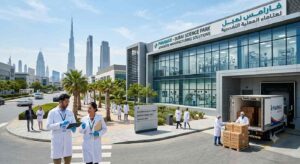
Dubai did not just create generic business parks; it built clusters tailored to specific industries. For life sciences, Dubai Science Park brings together pharma firms, biotech ventures, laboratories, distributors, and healthcare suppliers in one connected community.
Clustering has quiet advantages. Suppliers, specialists, and potential partners sit close by, regulators understand the sector, and the shared infrastructure, from labs to warehousing, is built with medicine in mind. For a company weighing where to land, a purpose-built home like this removes a lot of early friction and plugs it straight into the pharmaceutical industry in Dubai.
Ownership rules, tax incentives, and licensing perks
Free zones long offered a headline benefit that mattered enormously to foreign firms: full ownership of your own business, with no obligatory local majority partner. Reforms in recent years extended full foreign ownership to many mainland activities too, widening the options.
On tax, the Emirates has introduced a federal corporate tax, but free zones can still offer meaningful relief on qualifying income, and the broader environment, with no personal income tax and streamlined customs, remains generous by global standards. Add straightforward licensing and business-friendly administration, and the financial case for basing operations here holds up well.
Logistics and cold-chain infrastructure that support scale
Medicine is fragile. Many products spoil if they get too warm, so the ability to keep a controlled temperature from factory to pharmacy is not a nice-to-have; it is the whole game. Dubai has invested heavily in cold-chain capacity, temperature-controlled warehousing, and airport and seaport handling built for sensitive cargo.
This infrastructure is what lets companies operate at scale and serve distant markets with confidence. A shipment can be produced, stored, cleared, and flown out without ever breaking the cold chain. That reliability is a genuine competitive edge, and it underpins much of the export ambition driving the pharmaceutical industry in Dubai.
The Wider UAE Picture: Pharmaceutical Companies in Abu Dhabi
Dubai grabs headlines, but it shares a country with six other emirates, and the capital in particular has become a serious force in medicine. To understand the market properly, you have to zoom out.
How the capital complements Dubai’s ecosystem
Abu Dhabi has leaned into healthcare and life sciences as part of its own long-term diversification plans, backing manufacturing, research, and biotech ventures with deep pockets and clear intent. A growing roster of pharmaceutical companies Abu Dhabi has nurtured now spans local production, specialty supply, and homegrown research efforts.
Rather than competing head-on, the two emirates tend to complement each other. Where Dubai excels at trade, logistics, and being a commercial gateway, Abu Dhabi brings heavier industrial investment and research muscle. Together they give companies a fuller ecosystem than either could offer alone, and many firms end up with a foot in both.
Cross-emirate collaboration and shared supply chains
Because the Emirates functions as a single country with a shared federal framework, medicine moves fairly freely between the emirates. A drug registered nationally can be sold across all of them, and supply chains routinely stitch together sites in different cities.
This means a product might be manufactured or packaged near the capital, warehoused and distributed through Dubai’s logistics hubs, then exported onward. The rise of pharmaceutical companies Abu Dhabi has invested in feeds directly into the wider network, and that cooperation strengthens the pharmaceutical industry in Dubai as much as it does the capital’s own. When one part of the country builds capacity, the whole system benefits.
Where the Real Opportunities Lie
For all the growth, this is not a saturated market with every gap already filled. There is genuine room to build, and the clearest openings fall into a few distinct areas.
Manufacturing, R&D, and contract production gaps
The most obvious opportunity is production itself. Since so much medicine and nearly all raw material is still imported, every plant that opens locally chips away at that dependency. There is appetite for more formulation, more packaging, and more capacity in categories the region relies on heavily.
Contract manufacturing is a particularly practical route. A company can produce on behalf of brands that want a local footprint without building their own factory, sharing capacity and spreading risk. Research and development lags further behind, which paradoxically makes it a wide-open field for firms willing to invest early in labs and clinical work. Contract production, in particular, could become a real strength of the pharmaceutical industry in Dubai.
Distribution, digital health, and e-pharmacy openings
Beyond making medicine, there is money in moving and selling it smarter. The region is embracing digital health, from telemedicine to app-based prescriptions, and e-pharmacy is steadily gaining ground as regulations catch up with consumer habits.
For companies with strong technology and logistics, this is fertile territory. Online ordering, home delivery of chronic-disease medication, and digital tools that keep patients on their treatment plans all address real needs. Distribution networks that combine physical reach with slick digital ordering are well placed to capture the next wave of growth.
Partnership and franchising routes for foreign firms
Not every company wants to build from scratch, and they do not have to. The market has long welcomed foreign firms that partner with established local players who already understand the regulations, the buyers, and the culture. Distribution agreements, joint ventures, and franchising arrangements let outsiders enter quickly with a trusted guide beside them.
These partnerships lower the barrier to entry considerably. A global manufacturer can gain shelf space and regulatory know-how through a local ally, while the local partner gains access to sought-after products. For many, this collaborative approach is the smartest first step into the pharmaceutical industry in Dubai.
Hurdles Worth Planning For
No market is all upside, and pretending otherwise helps nobody. Anyone serious about entering should walk in with clear eyes about the friction points.
Competition, pricing pressure, and talent shortages
Success attracts crowds. Because this market is so appealing, plenty of global and regional players already compete here, and standing out takes real effort and a genuine value proposition. Meanwhile, the same price controls that keep the market orderly also cap how much room there is to charge premium margins, which squeezes profitability on commodity products.
Talent is another quiet challenge. Skilled pharmacists, regulatory specialists, and experienced production staff are in demand, and finding, hiring, and keeping them can be tough and expensive. Companies that invest in training and treat their people well tend to weather this better than those competing purely on salary.
Navigating dependency on imported raw materials
The single biggest structural weakness is reliance on imported inputs. Even locally made medicine usually depends on active ingredients and packaging materials sourced from abroad, which means a global supply shock, a shipping crisis, or a price spike somewhere far away can ripple straight through to local operations.
Managing this risk takes foresight: keeping sensible inventory buffers, cultivating multiple suppliers rather than a single source, and, over time, backing efforts to produce more inputs regionally. It is a real vulnerability, but it is also, as the earlier sections suggested, one of the very opportunities driving new investment.
The Road Ahead for Dubai’s Pharma Sector
So where does all of this lead? The direction of travel is clear even if the exact pace is not, and the coming years look set to reshape the market in meaningful ways.
Localization goals and self-sufficiency ambitions
The overriding theme is self-reliance. National strategies openly aim to produce more medicine at home, cut import dependence, and make sure the country can supply essential drugs even when global chains falter. This is not just economic policy; after recent global disruptions, it is treated as a matter of security.
For companies, that ambition translates into support: incentives to manufacture locally, encouragement for research, and a government eager to see the sector grow roots rather than remain a warehouse. Businesses that align with these localization goals are likely to find doors opening rather than closing.
Innovation, sustainability, and the next decade
Looking further out, three threads will define the next decade. Innovation, as the market keeps moving toward biologics, specialty care, and digital-first delivery. Sustainability, as the industry faces pressure to green its manufacturing, packaging, and cold-chain operations. And integration, as artificial intelligence, data, and connected health tools weave themselves into how medicine is developed, prescribed, and delivered.
Companies that read these trends early and build for them, rather than reacting late, will shape the pharmaceutical industry in Dubai for years to come. The market is young enough that the leaders of tomorrow are still being decided today.
Final Thoughts: Turning Growth Into a Foothold
Dubai has done something impressive in medicine: it has taken a role as a logistics middleman and steadily grown it into something far richer, a genuine hub for trade, distribution, and increasingly production and research. The pharmaceutical industry in Dubai now offers a rare mix of reliable demand, supportive policy, world-class infrastructure, and a gateway to enormous surrounding markets.
That does not mean it is easy money. Regulation is thorough, competition is real, and dependence on imported inputs is a lingering weakness. But for companies that come prepared, respect the rules, choose the right partners, and align with the country’s push toward self-reliance, the opportunity is substantial. The smart move is not to chase the growth for its own sake, but to build a durable foothold, one grounded in quality, patience, and a clear read of where the market is heading. Do that, and Dubai’s pharma story becomes your story too.
Frequently Asked Questions
1. Why is Dubai important to the pharmaceutical industry?
Dubai’s strategic location, advanced logistics infrastructure, healthcare investment, and access to markets across the Middle East, Asia, and Africa make it an important pharmaceutical trade and distribution hub.
2. Is Dubai becoming a pharmaceutical manufacturing hub?
Yes. Dubai is gradually moving beyond pharmaceutical imports and distribution toward local formulation, packaging, manufacturing, and quality-control operations.
3. What makes Dubai a strategic gateway for pharmaceutical exports?
Dubai connects major markets across the Middle East, Indian subcontinent, and Africa. Its ports, airports, and logistics infrastructure allow pharmaceutical companies to distribute products efficiently to regional markets.
Website: Visit our official website to learn more.
Call Us: 82838 57755
Instagram: Follow us for the latest updates and industry insights.
Facebook: Join our community and stay connected.