Nobody standing at a pharmacy counter thinks about how the box in their hand got there. They just expect it to be available. That expectation only holds up because of a chain of work happening quietly in the background — and medicine distributors are the ones doing most of that heavy lifting.Think of a manufacturer as a factory that can produce enormous volumes of a drug in one location. That factory has no realistic way of dropping off small quantities to thousands of individual pharmacies, hospital wards, and neighborhood clinics scattered across a country. That gap between mass production and localized, small-scale need is exactly where distributors step in.
A few things become clear once you look closely at this role:
- Manufacturers rely on distributors to break bulk production into usable quantities that match what individual buyers can actually handle.
- Every pharmacy shelf that stays consistently stocked is, in some way, a reflection of how well the distribution chain behind it is functioning.
- A breakdown anywhere in that chain — a late shipment, a missed reorder, a compliance lapse — ripples outward and eventually reaches the patient waiting on a prescription.
Choosing the right Medicine Distributors is a critical business decision for pharmacies, hospitals, and wholesale businesses. A reliable distribution partner ensures a consistent medicine supply, builds customer trust, and supports long-term business growth.
Understanding What Medicine Distributors Actually Do
Medicine Distributors do much more than deliver pharmaceutical products. They coordinate sourcing, inventory management, quality compliance, warehousing, and logistics to ensure medicines reach healthcare providers efficiently.
Managing Procurement and Inventory
The strongest distributors aren’t reactive. They don’t wait until shelves are nearly empty before scrambling to restock. Instead, they build ongoing sourcing relationships that keep supply steady well before shortages become visible.
- They screen manufacturers carefully, checking production standards and past performance before agreeing to carry their products.
- They hold buffer stock specifically to absorb sudden demand spikes, whether that’s a seasonal illness surge or an unexpected local outbreak.
- They walk a fine line between overstocking, which locks up money in unsold inventory, and understocking, which sends customers looking elsewhere.
Distributors who manage this balance well tend to earn repeat business rather than one-off orders.
Ensuring Timely Deliveries
Reliable Medicine Distributors combine efficient transportation with strong supply chain management to ensure medicines reach pharmacies, hospitals, and healthcare providers safely and on time.
- Many pharmaceutical products need temperature control, careful handling, or protective packaging during transit, and distributors build their logistics around those requirements.
- Route planning matters more than people realize — a poorly planned delivery schedule can turn a same-day order into a multi-day wait.
- For time-sensitive treatments, a delay isn’t just inconvenient. It can directly affect whether a patient’s treatment plan stays on schedule.
Supporting Regulatory Compliance
Medicines aren’t ordinary retail products, and the paperwork trailing behind them reflects that. Distributors operate under rules that most other supply chains never have to think about.
- Every batch needs traceable documentation — manufacturing origin, expiry dates, and quality certification all have to be verifiable.
- Storage conditions are tightly controlled, since many drugs degrade quickly if exposed to the wrong temperature, humidity, or light levels.
- A distributor serious about compliance is, in effect, protecting two things at once: their own operating license and the safety of every patient downstream.
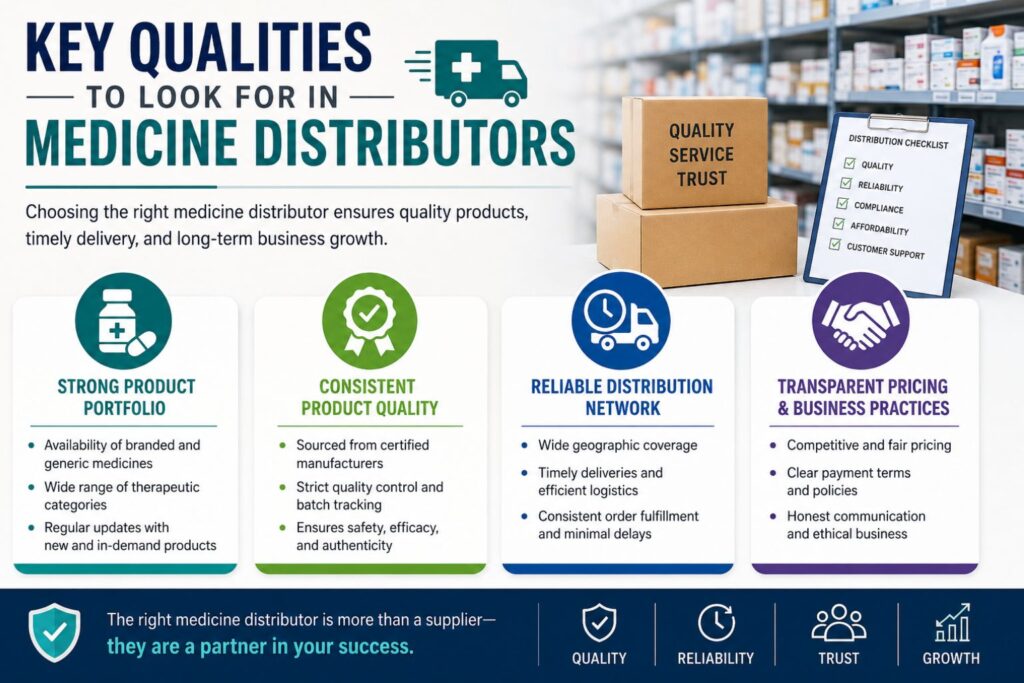
Key Qualities to Look for in Medicine Distributors
Some distributors operate at a genuinely higher standard than others. Knowing what separates them makes the evaluation process much easier.
Strong Product Portfolio
The best Medicine Distributors offer a comprehensive product portfolio, allowing businesses to source a wide range of medicines from one trusted partner instead of managing multiple suppliers.
- Look for coverage across both branded and generic options, since that flexibility lets you respond to different budgets and prescriptions.
- Broad representation across therapeutic categories — from cardiac care to dermatology to antibiotics — means fewer separate supplier relationships to manage.
Consistent Product Quality
Pricing conversations matter, but they shouldn’t come before quality. There’s too much riding on these products for shortcuts to be acceptable, and this is exactly where dependable Medicine Distributors set themselves apart from the rest.
- Trustworthy distributors work only with manufacturers who follow recognized production standards.
- Batch-level tracking allows any quality concern to be traced back to its exact source quickly, rather than turning into a wider, harder-to-contain problem.
Reliable Distribution Network
Even excellent products lose their value if the network moving them is patchy or unpredictable.
- Geographic reach is worth checking carefully — does the distributor actually operate where your business needs them to?
- Fulfillment speed says a lot about internal organization. A distributor who takes weeks to process routine orders will eventually become a liability.
Transparent Pricing and Business Practices
Few things damage a supplier relationship faster than pricing surprises or shifting terms after the fact.
- Competitive rates are important, but they should never hide behind unclear invoicing or last-minute charges.
- Payment terms, credit periods, and return policies should be spelled out clearly from the start and honored consistently afterward.
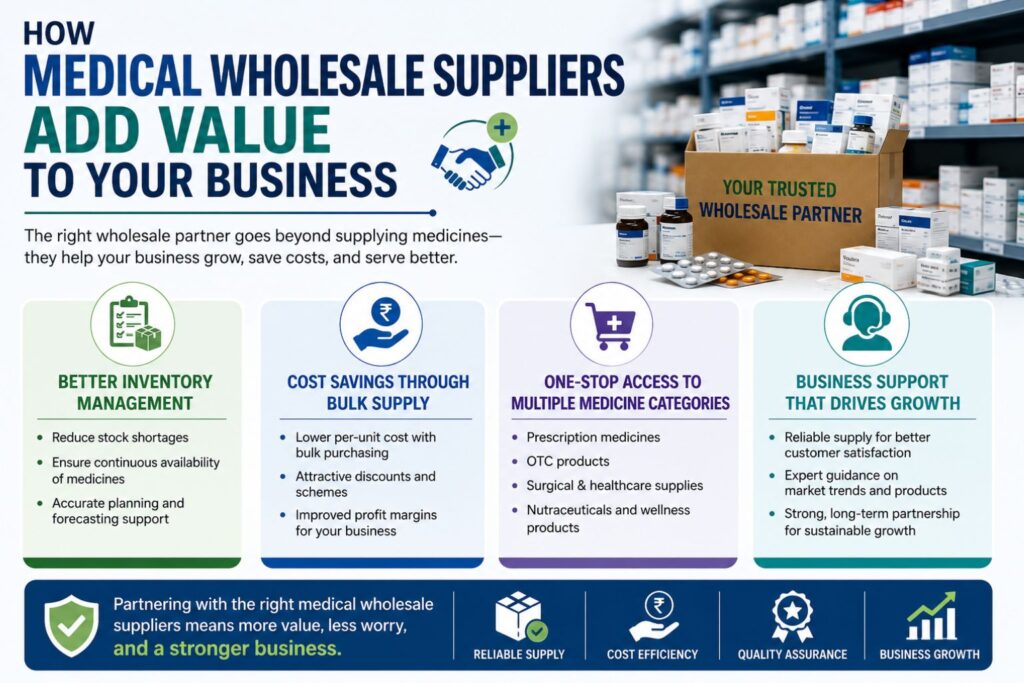
How Medical Wholesale Suppliers Add Value to Your Business
Partnering with an established medical wholesale supplier tends to deliver benefits that go well beyond simply receiving stock on schedule, which is why many businesses lean on experienced Medicine Distributors to handle this side of operations entirely
Better Inventory Management
- Suppliers with strong internal systems typically carry larger reserves, which lowers your risk of running short during unexpected demand spikes.
- Bulk purchasing becomes far more manageable when it’s routed through one dependable source instead of split across several smaller vendors.
Cost Savings Through Bulk Supply
- Ordering in volume usually unlocks better pricing brackets, which strengthens margins over time.
- For high-turnover products reordered frequently, those savings compound into a meaningful difference acrossa full year.
One-Stop Access to Multiple Medicine Categories
Rather than sourcing each category separately, a capable wholesale partner can often cover most needs through a single relationship, which is one of the main reasons businesses prefer working with full-service Medicine Distributors:
- Prescription medicines spanning a range of therapeutic areas
- Over-the-counter products for everyday health concerns
- General healthcare essentials, including supplements and diagnostic supplies
Reliable Medicine Distributors simplify procurement by offering a wide range of medicines through a single supply channel, reducing administrative work and making inventory management more efficient.
Questions to Ask Before Finalizing a Medicine Distributors
A short round of due diligence before signing any agreement tends to reveal far more about a distributor than their sales presentation ever will.
Are They Licensed and Certified?
When evaluating Medicine Distributors, verifying licenses, certifications, and regulatory documents is essential. Working with an uncertified distributor can expose your business to legal issues, supply chain disruptions, and reputational damage.
Can They Handle Growing Order Volumes?
What works for your business today may not match what you need a year from now. Ask how the distributor has scaled with other clients, and whether their warehousing, transport, and staffing can grow alongside your demand.
What Is Their Delivery Performance Record?
Don’t rely on assurances alone. Ask for references or a track record that shows consistent, on-time delivery over an extended stretch — not just a handful of strong months.
Do They Offer Responsive Customer Support?
Something will eventually go wrong — a delayed shipment, a documentation question, a damaged batch. What actually matters is how quickly and effectively the distributor responds when it does.
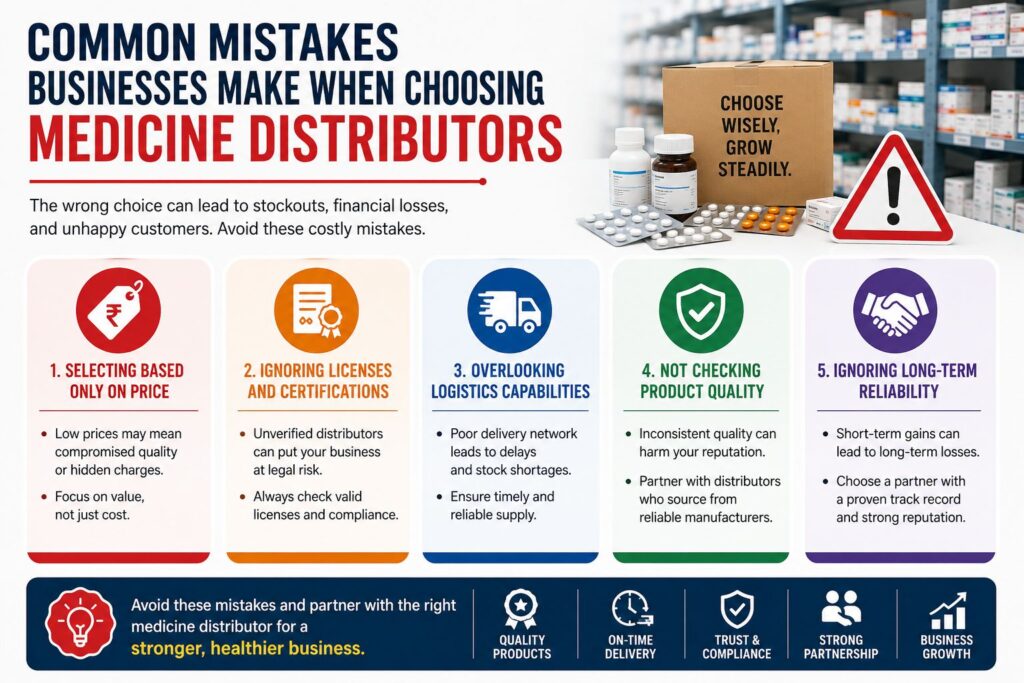
Common Mistakes Businesses Make When Choosing Medicine Distributors
Even seasoned procurement teams fall into a few recurring traps. Watch out for these:
- Choosing based on price alone — the lowest quote often carries hidden trade-offs in quality, reliability, or compliance that surface only after the relationship is underway.
- Skipping compliance checks — cutting this corner to save time can create serious safety and regulatory problems down the line.
- Underestimating logistics capability — a distributor with great products but weak delivery infrastructure will eventually let you down.
- Ignoring long-term reliability — strong performance in month one doesn’t guarantee strong performance a year into a steady order relationship.
Avoiding these pitfalls usually comes down to proper upfront evaluation rather than rushing to sign.
How Technology Is Improving Modern Medicine Distribution
Distribution has shifted noticeably over recent years, largely driven by broader technology adoption across the supply chain.
Digital Order Management
Modern Medicine Distributors are replacing paper-based ordering with digital systems that allow pharmacies and clinics to place, track, and manage orders in real time, reducing errors and delivery delays.
Real-Time Inventory Tracking
Modern tracking tools show exact stock positions at any given moment, helping Medicine Distributors and buyers plan reorders based on data rather than guesswork.
Supply Chain Transparency
Technology now makes it far easier for Medicine Distributors to trace a product’s path from manufacturer to end user, strengthening accountability and speeding up how quickly issues get resolved.
Faster Communication and Support
Modern Medicine Distributors use automated alerts, dedicated support teams, and real-time tracking dashboards to keep businesses informed about order status and delivery schedules without unnecessary delays.
Why Biomorph Life Sciences Is a Trusted Choice for Medicine Distribution
Among the many Medicine Distributors in the market, Biomorph Life Sciences has built its reputation around a handful of consistent principles that matter most to the businesses it works with.
- Commitment to quality and compliance — every product handled undergoes proper verification, so pharmacies and healthcare providers receive medicines meeting required safety and quality benchmarks.
- Extensive product portfolio — coverage spans prescription drugs across multiple therapeutic categories along with OTC essentials, cutting down the need to juggle several suppliers.
- Efficient supply chain and nationwide delivery — a well-organized logistics setup helps ensure orders reach their destination without unnecessary delay, even across different regions.
- Customer-focused business approach — transparent pricing, clear communication, and responsive support keep the working relationship straightforward rather than stressful.
- Long-term partnership benefits — rather than treating each order as an isolated transaction, the focus stays on building relationships that support steady, uninterrupted supply over time.
For businesses seeking a distribution partner that pairs reliability with real accountability, this kind of approach tends to make a tangible difference in everyday operations.
Final Thoughts
Selecting the right medicine distributors isn’t a decision worth rushing or basing purely on whoever quotes the lowest number. It calls for a close look at product quality, regulatory compliance, delivery consistency, and how openly a partner communicates around pricing and terms.Working with dependable medical wholesale suppliers brings tangible advantages — steadier inventory, stronger margins through bulk purchasing, and simplified access to a wide range of medicine categories through one relationship. Cutting corners during selection, on the other hand, tends to surface bigger problems later, whether that’s compliance trouble, inconsistent stock, or logistics breakdowns that affect patient care directly.At the end of the day, your distribution partner becomes woven into how your business actually functions day to day. Take the time to ask the right questions, verify credentials properly, and choose a partner capable of scaling alongside you. A dependable distribution relationship does more than keep shelves stocked — it supports sustainable growth and helps ensure that the people relying on these medicines never face unnecessary delays or shortages.