Introduction
Walk into any conversation about the pharmaceutical trade and you’ll notice something odd — people use the words “manufacturer” and “supplier” as if they mean the same thing. A hospital procurement officer might say “our supplier makes this tablet” when, in reality, the company sitting across the table never touched a single raw material. It simply moves finished goods from one point to another. This mix-up isn’t just a language slip; it shapes decisions worth lakhs, sometimes crores, of rupees.For hospitals, pharmacies, distributors, startups, and franchise businesses, this confusion carries real consequences. A hospital that assumes it’s buying from a pharma manufacturer might end up with no direct accountability when a batch fails quality checks. A startup founder dreaming of launching a private-label medicine range could waste months negotiating with a trading company that has no production facility at all. Franchise owners often sign agreements believing they’re tied to a manufacturing partner, only to discover later that their actual point of contact is a middleman with limited control over pricing or supply continuity.This guide breaks down exactly what separates a pharma manufacturer from a supplier — not in vague textbook language, but in practical terms that matter for your business. You’ll learn what each party actually does, how products travel from a lab to a pharmacy shelf, and which one you should be talking to depending on your specific goals. By the end, you’ll be equipped to ask the right questions before signing any contract, so you never confuse a trading desk with a production unit again.
What Is a Pharma Manufacturer?
A pharma manufacturer is the entity that actually produces medicines — from formulation to the final sealed pack. This isn’t a company that simply buys and resells; it owns or operates the plant, machinery, and technical workforce required to turn chemical compounds into tablets, capsules, syrups, injectables, or ointments. When you deal directly with a pharma manufacturer, you’re dealing with the source, not a relay point.
Core Responsibilities of a Pharma Manufacturer
A manufacturing unit carries a heavy list of duties that go far beyond simply “making medicine.” These responsibilities typically include:
- Formulating and testing drug compositions for safety and efficacy
- Sourcing approved raw materials and active pharmaceutical ingredients
- Operating production lines under strict hygiene and safety protocols
- Running in-house quality control and quality assurance checks
- Maintaining detailed batch records for regulatory audits
- Managing product recalls if any safety concern arises
Each of these tasks demands specialized infrastructure and trained personnel, which is exactly why not every business in the pharma trade can call itself a manufacturer.
From Research to Finished Pharmaceutical Products
The journey inside a manufacturing facility starts long before a tablet takes shape. Formulation scientists work on the right combination of active ingredients and excipients, running stability trials to check how the product behaves under different storage conditions. Once a formula is finalized, it moves to pilot-scale production, then to full commercial batches. Every stage is documented, because regulators expect complete traceability from the very first trial to the last commercial unit sold.
Quality Standards, Compliance, and Certifications
This is where a genuine pharma manufacturer separates itself from casual players in the market. Reputable manufacturing units operate under certifications such as WHO-GMP, ISO standards, and approvals from national drug regulatory bodies. These certifications aren’t decorative logos on a website — they represent audited processes, validated equipment, and documented accountability. A manufacturer without such certifications should raise immediate red flags for anyone considering a long-term partnership.
Who Typically Works with a Pharma Manufacturer?
Businesses that need direct control over formulation, packaging, and branding usually work with a manufacturer. This includes:
- Pharma companies launching their own product line
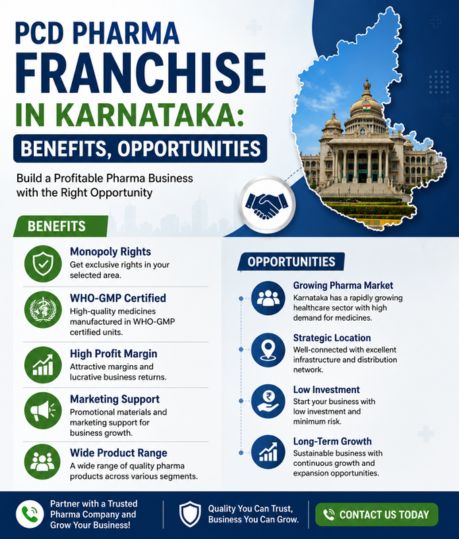
- Franchise and PCD pharma businesses needing bulk production
- Hospitals or institutions requiring customized formulations
- Export businesses needing certified, compliant products
What Does a Pharmaceutical Supplier Actually Do?
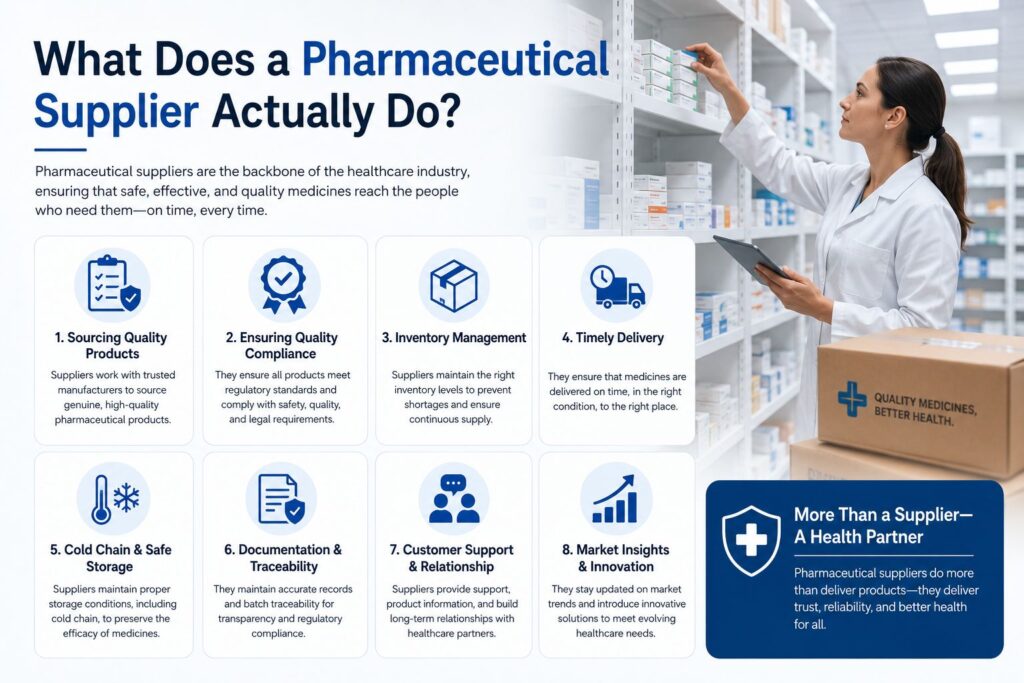
A pharmaceutical supplier operates on a completely different plane. Rather than producing medicines, a supplier sources finished products — often from multiple manufacturers — and moves them through the supply chain to reach pharmacies, hospitals, clinics, and retail outlets. Think of a supplier as the connective tissue between production and consumption.
The Supplier’s Role in the Healthcare Supply Chain
A supplier’s core job is availability. They make sure that when a pharmacy needs a particular brand of antibiotic or a hospital needs a bulk order of IV fluids, the product is ready, packed, and deliverable within a short window. Suppliers rarely get involved in formulation decisions; their expertise lies in logistics, storage, and timely fulfillment.
Product Sourcing, Inventory, and Distribution
Suppliers maintain relationships with several manufacturing units simultaneously, allowing them to offer a wide catalog without being tied to a single production line. Their operational focus includes:
- Negotiating purchase agreements with multiple manufacturers
- Warehousing products under proper temperature and humidity control
- Managing stock rotation to prevent expiry-related losses
- Coordinating transportation to distributors, pharmacies, or hospitals
Different Types of Pharmaceutical Suppliers
Not all suppliers function the same way. Some common categories include:
- Wholesale suppliers — dealing in bulk quantities for large institutions
- Regional distributors — covering specific geographic territories
- Specialty suppliers — focusing on niche categories like oncology or biologics
- Import-export suppliers — handling cross-border pharmaceutical trade
Industries and Businesses That Depend on Suppliers
Retail pharmacies, small clinics, nursing homes, and even large hospital chains often rely on suppliers rather than manufacturers because they need variety, smaller order quantities, and faster turnaround. A pharmacy stocking hundreds of SKUs simply cannot maintain direct manufacturer relationships for every single product — that’s where a reliable supplier becomes indispensable.
Pharma Manufacturer vs Supplier: A Side-by-Side Comparison
Now that both roles are clear individually, let’s place them side by side to see exactly how a pharma manufacturer differs from a supplier across the factors that matter most to buyers.
Ownership of Production
A manufacturer owns the plant, equipment, and formulation process. A supplier owns none of this — they simply hold purchasing relationships and warehousing capability.
Product Quality and Regulatory Responsibility
Quality accountability sits squarely with the manufacturer, since they control every input and process step. A supplier’s responsibility is limited to proper storage and handling; they cannot alter or guarantee the composition of what they’re distributing.
Pricing Structure and Profit Margins
Because a manufacturer eliminates the middle layer, pricing from a manufacturer is typically more competitive for bulk orders. Suppliers, working with added logistics and margin layers, often price products slightly higher, especially for smaller order quantities.
Custom Manufacturing Capabilities
If you need a unique formulation, custom packaging, or private branding, only a manufacturer can fulfill that. A supplier can offer you what already exists in their inventory — nothing more, nothing customized.
Inventory Management and Product Availability
Suppliers typically win here for immediate needs, since they carry ready stock across multiple brands. Manufacturers, especially for custom orders, require production lead time before goods are ready for dispatch.
Customer Relationships and Service Models
A manufacturer’s relationship is often deeper and more technical, involving formulation discussions, compliance documentation, and long-term contracts. A supplier’s relationship tends to be transactional, centered around order fulfillment and delivery timelines.
How Products Move from Manufacturing to the End Customer
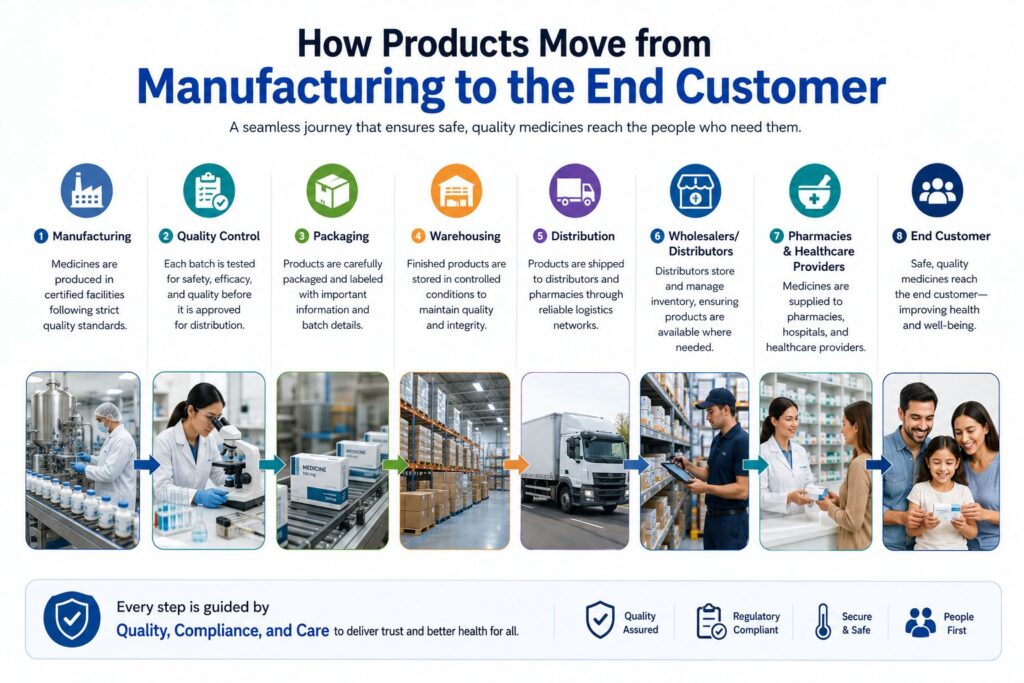
Understanding the full journey helps clarify why both a pharma manufacturer and a supplier are essential, even though their roles differ so sharply.
Raw Material Procurement
Everything begins with sourcing active pharmaceutical ingredients and excipients from approved vendors. This stage demands strict verification, since impure or substandard raw material can compromise an entire batch.
Pharmaceutical Manufacturing Process
Once materials are approved, production begins — mixing, granulation, compression, encapsulation, or filling, depending on the dosage form. Every machine run is logged, and samples are pulled for testing at multiple checkpoints.
Packaging, Warehousing, and Distribution
After production, products move into packaging lines where blister packs, bottles, or vials are sealed and labeled according to regulatory requirements. From there, goods enter warehousing — sometimes managed by the manufacturer, sometimes handed over to a supplier network for wider distribution.
Delivery to Pharmacies, Hospitals, and Healthcare Providers
The final leg involves suppliers and distributors delivering products to the point of sale or point of use. This stage requires careful temperature control for sensitive products and accurate order fulfillment to avoid stockouts at critical care facilities.
When Should You Partner with a Pharma Manufacturer Instead of a Supplier?
Certain business goals make a direct manufacturer relationship the smarter, more sustainable choice.
Launching Your Own Pharmaceutical Brand
If you’re building a brand from scratch, you need someone who can formulate under your specifications and produce under your label. Only a pharma manufacturer offers this level of control.
Third-Party Manufacturing Requirements
Businesses that want to outsource production while keeping their brand identity intact typically approach manufacturers offering third-party manufacturing services, where the manufacturer produces goods exclusively for the client’s brand.
Private Label and Contract Manufacturing Needs
Private labeling requires a manufacturer willing to adjust formulations, packaging design, and batch sizes according to a client’s specific market positioning — something a supplier simply cannot provide.
Long-Term Production Partnerships
If your business plans to scale over years, not months, building a direct relationship with a manufacturer offers stability, better pricing over time, and priority access to production slots during high-demand periods.
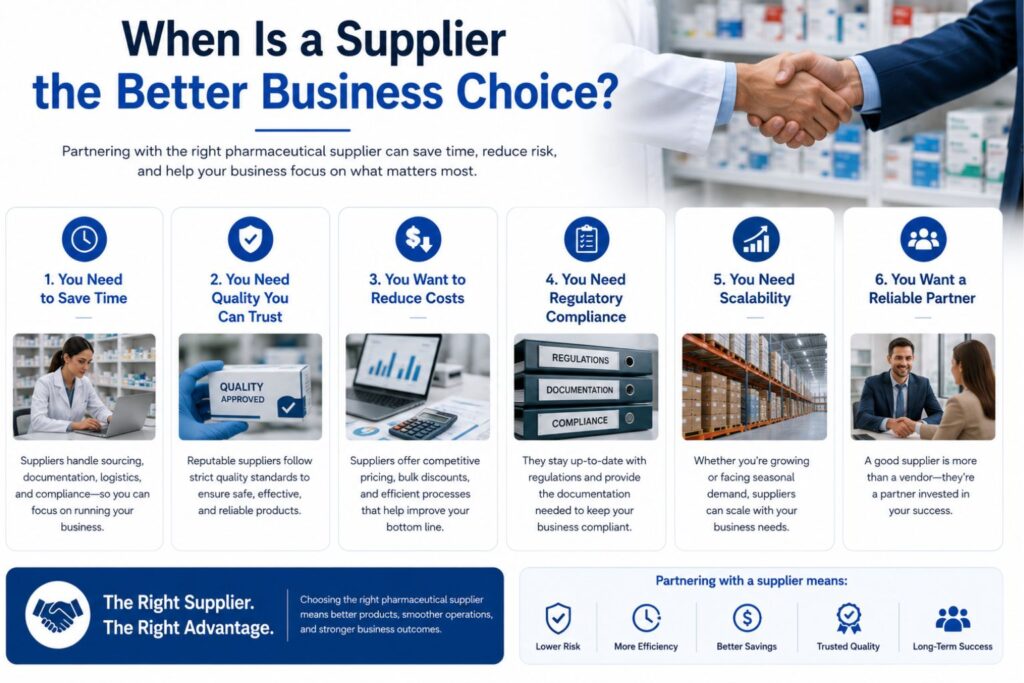
When Is a Supplier the Better Business Choice?
There are equally valid situations where working with a supplier makes far more practical sense.
Immediate Product Availability
When you need stock urgently — say, a pharmacy running low on a fast-moving product — a supplier’s ready inventory beats waiting for a fresh manufacturing batch.
Smaller Purchase Volumes
Manufacturers often set minimum order quantities that don’t suit small businesses. Suppliers, by contrast, are built to handle smaller, more frequent orders.
Multi-Brand Product Requirements
If your business needs products from dozens of different brands, coordinating with each individual manufacturer would be a logistical nightmare. A single supplier relationship simplifies this considerably.
Simplifying Procurement Across Categories
Suppliers who deal across multiple therapeutic categories allow buyers to consolidate purchasing, reducing the administrative burden of managing numerous vendor accounts.
Common Misunderstandings That Can Lead to Costly Business Decisions
Assuming Every Supplier Is a Manufacturer
Many suppliers use manufacturing-sounding language in their marketing, even though they don’t own a single production facility. Always verify before assuming.
Confusing Brand Ownership with Product Production
Owning a brand name doesn’t mean owning the manufacturing process. Plenty of brand owners outsource production entirely while retaining full control over marketing and sales.
Ignoring Regulatory Responsibilities
Buyers sometimes forget that liability for a defective product often traces back to the manufacturer, not the supplier who merely delivered it. Understanding this distinction matters when quality issues arise.
Choosing Only on Price Instead of Capability
The cheapest quote doesn’t always come from the most capable partner. A low-priced supplier with unreliable stock, or an uncertified manufacturer offering rock-bottom rates, can cost far more in the long run through delays, recalls, or compliance penalties.
Factors to Evaluate Before Choosing a Pharma Manufacturing or Supply Partner
Regulatory Compliance and Certifications
Always verify licenses, GMP certifications, and drug approval documentation before finalizing any partnership, whether it’s with a manufacturer or a supplier.
Manufacturing Capacity and Product Portfolio
For manufacturers, check whether their production capacity matches your projected order volumes. For suppliers, review the breadth and depth of their existing product catalog.
Delivery Reliability and Supply Continuity
Ask about historical performance — how often do they meet delivery deadlines, and what happens during supply disruptions? Consistency here protects your business from unexpected stockouts.
Technical Support and Business Transparency
A trustworthy partner, manufacturer or supplier, should be willing to share documentation, answer technical questions, and maintain open communication about production timelines or stock availability.
Scalability for Future Growth
Consider whether your chosen partner can grow alongside your business. A manufacturer with limited capacity or a supplier with a narrow network might become a bottleneck as your operations expand.
Why Working Directly with the Right Pharma Manufacturer Can Create Long-Term Value
Better Cost Control
Cutting out unnecessary intermediaries allows businesses to negotiate more favorable pricing directly with the source of production, especially for high-volume orders.
Consistent Product Quality
Direct oversight of formulation and production means fewer surprises. When you work closely with a manufacturer, you gain visibility into quality processes that a supplier relationship simply cannot offer.
Greater Customization Options
From dosage forms to packaging design, a manufacturer can tailor products to match your brand vision, something impossible when purchasing pre-made stock through a supplier.
Stronger Brand Development Opportunities
Businesses aiming to build a recognizable identity in the pharmaceutical space benefit enormously from manufacturer partnerships that support private labeling, custom formulations, and exclusive product lines.
Frequently Asked Questions
Is every pharmaceutical supplier also a pharma manufacturer?
No. Many suppliers operate purely as trading or distribution businesses without owning any production facility. Always confirm manufacturing credentials separately.
Can a pharma manufacturer sell products directly to pharmacies?
Yes, some manufacturers maintain direct distribution channels, though many prefer working through suppliers and distributors to reach a wider retail network efficiently.
Which option is more suitable for a pharma startup?
Startups planning to launch their own brand typically benefit more from partnering with a manufacturer, especially for third-party or contract manufacturing arrangements.
How can I verify whether a company is a genuine manufacturer or only a supplier?
Request their manufacturing license, GMP certification, and plant address. A genuine manufacturer will readily share this documentation; a pure supplier usually cannot.
Does buying directly from a pharma manufacturer reduce costs?
In most cases, yes, particularly for bulk orders, since there’s no intermediary margin added to the final price.
Conclusion
The line between a pharma manufacturer and a supplier isn’t just industry jargon — it’s a distinction that directly affects pricing, quality accountability, customization ability, and long-term business stability. A manufacturer owns the production process from formulation to finished product, while a supplier focuses on sourcing, storing, and distributing what’s already been made.
Choosing the right partner ultimately comes down to your specific business goals. If you’re building a brand, need customized formulations, or are planning long-term production partnerships, a manufacturer is the natural choice. If your priority is immediate availability, smaller order volumes, or access to multiple brands under one roof, a supplier serves that need better.
Whichever path fits your business, make your decision based on compliance, reliability, and long-term value — not just the lowest quote on the table. A well-informed choice today can save you from costly disruptions, quality issues, and missed growth opportunities tomorrow.