
Magnesium is one of those nutrients that rarely gets attention until someone starts looking more closely at everyday nutrition. It is naturally present in foods such as nuts, seeds, beans, whole grains, and green leafy vegetables, and it contributes to several normal processes in the body. The mineral is involved in enzyme activity, muscle and nerve function, energy production, and the movement of calcium and potassium across cell membranes.That explains why a magnesium dietary supplement appears in so many nutrition stores, pharmacies, wellness products, and daily supplement routines. However, seeing magnesium on a label does not automatically tell you whether one product is the same as another. The form of magnesium, amount provided, additional ingredients, serving size, and intended use can all vary.A thoughtful approach starts with understanding the nutrient rather than choosing a product because of a bold claim on the front of the package. A magnesium dietary supplement can be useful when dietary intake does not adequately meet an individual’s nutritional needs, but supplements are generally intended to complement a balanced diet rather than replace it.
This guide looks at what magnesium does, where it comes from, how different supplement forms compare, how to read a label, and what to consider before purchasing a product.
Why Magnesium Matters for Your Body
The National Institutes of Health notes that magnesium participates in more than 300 enzyme systems, including processes related to protein synthesis, energy production, muscle and nerve function, and the regulation of blood glucose and blood pressure.
This wide involvement is one reason magnesium is considered an important part of normal nutrition. It is not simply a mineral associated with one particular body function. Instead, it contributes to several interconnected processes that keep normal physiological activity running.
For people evaluating a magnesium dietary supplement, this broader role is worth remembering. A supplement should not be viewed as a quick solution for every wellness concern. Its basic purpose is to provide magnesium as part of an overall nutritional strategy.

Where Magnesium Fits Into Everyday Nutrition
Food is a natural starting point for getting magnesium. Green vegetables, legumes, nuts, seeds, and whole grains can all contribute meaningful amounts. Some fortified foods and beverages may also contain the mineral.
For example, pumpkin seeds, chia seeds, almonds, spinach, cashews, black beans, and brown rice are among the foods that can contribute magnesium to the diet. The amount obtained from food depends on portion size, food selection, preparation, and the overall eating pattern.
This is important when considering a magnesium dietary supplement because the product should be considered alongside what someone already gets from food. A person whose diet already contains several magnesium-rich foods may have different needs from someone whose everyday meals provide relatively little of the mineral.
Nutrition also varies between individuals. Age, sex, life stage, eating habits, and certain health circumstances can affect nutritional requirements. For adults, recommended magnesium intakes generally range from 310 to 420 mg per day depending on age and sex, although these figures refer to total intake rather than a recommended supplement dose.
Magnesium Dietary Supplement: What Exactly Is It?
A magnesium dietary supplement is a product formulated to provide magnesium in a concentrated form. It may be sold as a capsule, tablet, powder, liquid, or another dosage format. The magnesium itself is usually attached to another compound, which creates different forms such as citrate, oxide, chloride, or glycinate.
That distinction matters because the amount of the entire magnesium compound is not necessarily the amount of magnesium supplied to the body. Supplement labels report the amount of elemental magnesium in the Supplement Facts panel, rather than simply listing the weight of the complete magnesium compound.
This is one of the easiest details to overlook when comparing products. Two containers may show different compound names and quantities while providing different amounts of elemental magnesium.
The formulation can also influence absorption and tolerability. Research summarized by the NIH indicates that some forms dissolve more readily and can have greater bioavailability than forms such as magnesium oxide.
Common Types of Magnesium Found in Supplements
- Magnesium citrate: Frequently used in dietary supplements and generally considered relatively well absorbed.
- Magnesium glycinate: A form in which magnesium is associated with glycine and is commonly found in capsules and tablets.
- Magnesium oxide: Contains a relatively high proportion of elemental magnesium but is less soluble than several other forms.
- Magnesium chloride: Another supplemental form that can be found in different formulations.
- Magnesium lactate, aspartate, and other forms: These may also appear depending on the product and formulation.
The form matters because absorption can differ between magnesium compounds. The NIH reports that citrate, chloride, lactate, and aspartate tend to have greater bioavailability than magnesium oxide and magnesium sulfate.
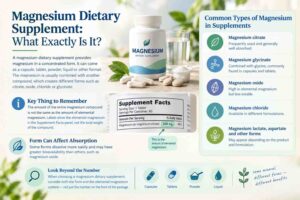
When choosing a magnesium dietary supplement, therefore, looking only at the number printed on the front of the package can be misleading. The form and elemental magnesium content deserve equal attention.
How to Understand a Magnesium Supplement Label
A good label can tell you considerably more than the product name. Start with the Supplement Facts panel and identify the amount of elemental magnesium supplied per serving.
For a magnesium dietary supplement, check the following:
- Serving size – Determine whether the listed amount applies to one capsule, two capsules, one scoop, or another serving.
- Elemental magnesium – Look for the actual amount of magnesium provided rather than only the compound weight.
- Magnesium form – Identify whether the product contains citrate, glycinate, oxide, chloride, or another form.
- Additional ingredients – Review sweeteners, colours, flavours, fillers, binders, and other components.
- Suggested use – Check how the manufacturer recommends the product be consumed.
- Manufacturer information – Look for clear product and company details.
Reading the label this way makes it easier to compare products on something more meaningful than packaging or marketing language.
It is also useful to compare the amount per serving with the rest of the daily diet. A magnesium dietary supplement may be used alongside fortified foods or a multivitamin, so the total supplemental intake should be considered rather than looking at one bottle in isolation.
Magnesium From Food or Supplements: What’s the Difference?
Food and supplements provide the same mineral, but they deliver it in very different contexts.
Foods containing magnesium also bring other nutrients, fibre, protein, healthy fats, carbohydrates, or naturally occurring compounds depending on the food. Nuts and seeds, for example, provide more than magnesium alone. Leafy vegetables and legumes similarly contribute to an overall dietary pattern.
A magnesium dietary supplement, on the other hand, provides a concentrated amount in a convenient format. This can be useful for people who have difficulty meeting particular nutritional needs through food alone or who have been advised to use supplementation.
The NIH generally emphasizes meeting nutritional needs primarily through food, while recognizing that dietary supplements can be useful in situations where food alone does not adequately provide specific nutrients.
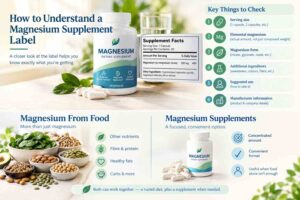
This does not mean one approach has to completely replace the other. A person can maintain a varied diet while using a magnesium dietary supplement when supplementation is appropriate.
Where Food Supplement Vitamins Fit In
The term food supplement vitamins covers a much broader category than magnesium alone. Such products may contain vitamins, minerals, or combinations of nutrients intended to supplement the diet.
Magnesium products can be formulated as single-mineral products or combined with other nutrients. FDA documentation notes that magnesium is available both as a single-ingredient supplement and in products containing other nutrients, including multivitamin and multimineral formulations.
This distinction is helpful when comparing food supplement vitamins with a dedicated magnesium product. A combination product may be convenient when several nutrients are needed, while a single-nutrient formula may make it easier to control the amount of one particular nutrient.
Before combining multiple food supplement vitamins, however, read each label carefully. Taking several products with overlapping ingredients can increase total supplemental intake without being obvious at first glance.
For example, someone might use a multivitamin, a mineral formula, and a separate magnesium dietary supplement without realizing that more than one product contains magnesium.
The same principle applies to other food supplement vitamins. Checking the full ingredient list helps prevent accidental duplication and makes daily intake easier to understand.
Choosing a Magnesium Dietary Supplement for Your Needs
There is no universal product that suits every person. Choosing a magnesium dietary supplement should begin with a simple question: why is the product being considered?If the goal is simply to increase magnesium intake, the next step is to assess the dietary pattern and review the product’s formulation. If supplementation is being considered because of a health condition, medication use, pregnancy, kidney problems, or another specific circumstance, professional guidance is more appropriate.
Once the purpose is clear, compare the products based on:
- Magnesium form
- Elemental magnesium per serving
- Serving size
- Other active ingredients
- Additional ingredients
- Manufacturer information
- Recommended use
- Quality and testing information
Price can be considered, but it should not be the only deciding factor. A cheaper product is not necessarily equivalent to a more expensive one if the formulations, serving sizes, or magnesium forms differ.

The same principle applies to food supplement vitamins. A product with a longer ingredient list is not automatically better. The useful question is whether the formulation makes sense for the intended nutritional purpose.
What Should You Check Before Buying?
Buying a magnesium dietary supplement becomes easier when you know which details deserve attention before placing an order.
Product Quality and Manufacturing Standards
Start by examining the manufacturer’s information. A reputable product should provide clear details about its formulation, serving size, ingredients, and directions.
Depending on the market, consumers may also want to look for information about manufacturing controls, testing, quality assurance, and product traceability. These details can be more useful than vague statements such as “premium” or “advanced” printed on the front of the package.
Quality considerations are equally relevant when purchasing food supplement vitamins. Since nutritional supplements can contain several active and inactive ingredients, transparent labeling is an important part of making a comparison.If a manufacturer provides information about testing, it should be specific enough to understand what is being tested and why. General quality language without supporting details provides less information to the buyer.
Dosage and Serving Information
The amount of magnesium deserves careful attention. Recommended dietary intake and supplemental upper limits are not the same thing.
For adults, the NIH lists a tolerable upper intake level of 350 mg per day for magnesium from dietary supplements and medications. This limit does not include magnesium naturally present in food.
That does not mean every adult should take 350 mg from supplements. It is an upper limit for supplemental magnesium, not a target dose.
A high-dose magnesium dietary supplement may also cause digestive effects such as diarrhea, nausea, or abdominal cramping, particularly when intake is excessive.
This is another reason not to assume that more is automatically better. When reviewing food supplement vitamins, the same principle applies: nutritional products should be used according to their intended purpose and appropriate directions.
Additional Ingredients
Not every product contains magnesium alone. Some formulations include flavouring agents, sweeteners, colours, binders, capsules, or additional nutrients.
There is nothing inherently wrong with additional ingredients, but they should be understood before purchase. Someone with dietary restrictions, allergies, sensitivities, or specific formulation preferences may want to examine this section more closely.
The same applies to food supplement vitamins containing multiple nutrients. A longer formula may be useful for one consumer and unnecessary for another.
For a magnesium dietary supplement, a simple ingredient profile can also make it easier to identify exactly what you are consuming.
Common Questions People Have About Magnesium Supplements
Q Can magnesium be obtained entirely from food?
For many healthy people, food is the preferred foundation for meeting nutrient needs. Magnesium is found in many commonly available foods, including nuts, seeds, legumes, whole grains, and green leafy vegetables.
Q How do different magnesium forms differ?
Different forms contain magnesium attached to different compounds. Their solubility and absorption can vary, and some forms may be better absorbed than others.
Q What should you look for on a magnesium supplement label?
Focus on elemental magnesium, serving size, magnesium form, other ingredients, directions, and manufacturer information.
The amount of elemental magnesium is particularly important because the Supplement Facts panel reports the actual magnesium amount rather than simply the total weight of the magnesium-containing compound.The same label-reading habit is useful with food supplement vitamins, especially combination products where several nutrients may appear together.
Q Can magnesium be included with other food supplement vitamins?
Yes. Magnesium can appear in products containing multiple vitamins and minerals. FDA information describes magnesium as an ingredient in multivitamin/multimineral supplements as well as standalone products.When using several food supplement vitamins, check for overlapping ingredients. This is particularly important if a separate magnesium dietary supplement is being taken alongside a multivitamin or mineral product.
Q How should you compare two magnesium products?
Begin with the elemental magnesium amount and form. Then compare serving size, additional ingredients, manufacturer information, suggested use, and price.A product containing 200 mg of elemental magnesium per serving is not directly comparable with one containing 400 mg simply because both are marketed as magnesium products. The serving size and intended daily use matter.
Final Thoughts
A magnesium dietary supplement is more than a bottle with the word “magnesium” printed on the front. The form of magnesium, elemental content, serving size, additional ingredients, manufacturing information, and intended use all deserve attention.Magnesium itself plays a wide-ranging role in normal nutrition and can be obtained from many foods. Nuts, seeds, legumes, whole grains, and leafy vegetables are useful dietary sources, while supplements provide a more concentrated option when appropriate.The best way to approach a magnesium dietary supplement is to understand what you are buying and why you are taking it. Rather than selecting a product because it has the highest number or the most impressive packaging, compare the formulation and label information carefully.The same thoughtful approach should be applied to food supplement vitamins. More ingredients, higher doses, and bigger claims do not automatically make a product more suitable.Ultimately, informed selection comes down to a few practical habits: understand your diet, read the label, compare elemental nutrient amounts, check the ingredients, and seek professional advice when your health circumstances or medications make supplementation more complicated.A well-chosen magnesium dietary supplement can fit into an overall nutrition strategy, but the foundation should remain a varied diet and sensible, informed supplement use
Website: Visit our official website to learn more.
Call Us: 82838 57755
Instagram: Follow us for the latest updates and industry insights.
Facebook: Join our community and stay connected.